
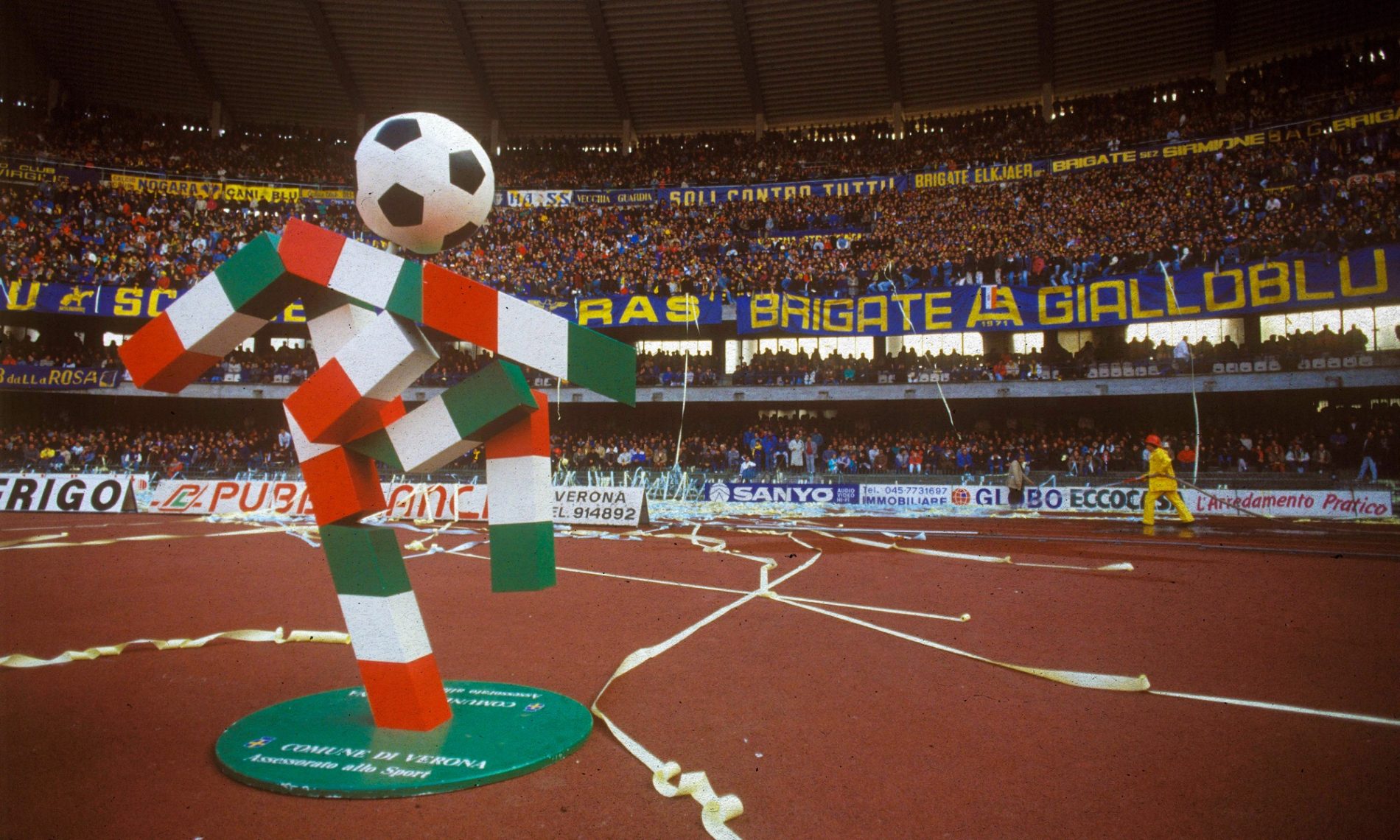
On and off the pitch, 1990 marked a turning point in Verona. In this exclusive Gentleman Ultra Long Read, Richard Hough, author of Verona Campione, the Miracle of 85, explores how shifts in fashion, music and football came together against the dramatic backdrop of an era-defining World Cup.
Hellas Verona’s remarkable Scudetto-winning season is perhaps unique in the annals of world football. For some it’s quite simply the greatest upset in the history of the game. The provincial upstarts seemed to come from nowhere to beat Platini’s Juventus, Maradona’s Napoli, Rummenigge’s Inter and Júnior’s Torino, to name-drop just a few of the global superstars plying their trade in Italy at a time when Serie A was the most competitive league in the world. In the intervening years, perhaps only Leicester City have come close to emulating the “miracle” of 1985.
By the time the 1990 World Cup rolled into town, the glow of winning that historic Scudetto had well and truly faded. At the end of the 1989/90 season, Hellas suffered the ignominy of relegation thanks to a 1-0 defeat to Marcello Lippi’s Cesena in the last game of the season, bringing the unprecedented era of success under wily coach Osvaldo Bagnoli crashing down just six years after that historic Scudetto. For local fans who had experienced those unparalleled moments of success, including a quarter final finish in the 1987 UEFA Cup, it was a devastating if not entirely unpredictable blow. But worse was to come. Having over-extended itself in the 1980s (who didn’t?) by the summer of 1990 Hellas Verona was a football club in deep financial trouble and on the brink of bankruptcy.
For local football fans there was, at least, some consolation that summer.
The World Cup was coming to Verona!

Italia ’90 Comes to Verona
Verona’s bid to be a World Cup host city was masterminded by Gabriele Sboarina, the city’s long-standing Christian Democratic mayor. Sboarina was known locally as Re (King) Lele (a contraction of “Gabriele”) due to his absolute control over every aspect of the city’s administration. A powerful advocate for Verona’s bid to be one of 12 host cities, Mayor Sboarina understood the importance of the World Cup for unlocking national funding streams to finance the modernisation of the city’s overloaded transport infrastructure and make ambitious improvements to the Bentegodi Stadium, including the addition of a new third tier and a roof.
In 1986, Verona’s bid to be a host city was approved and work began almost immediately. It wasn’t long, however, before the work ground to a halt. The discovery of a vast Roman necropolis meant that a team of international archaeologists, led by Englishman Peter Hudson, had to be brought in to excavate the site. Despite the significant delays caused by the dig, the tunnel and ring road project that would provide improved access to the stadium was somehow delivered on time.
When the era-defining tournament finally kicked off, the Bentegodi stadium hosted just four matches: three Group E games and one knockout fixture. Belgium was the protagonist of Verona’s group stage, with the “Red Devils” playing all three of their group fixtures at Verona’s newly upgraded Bentegodi stadium, as they eased to a Round of 16 meeting in Bologna with Bobby Robson’s England (spoiler alert: England won 1-0 thanks to a David Platt extra-time winner).
In Verona, it is the knockout match between Spain and Yugoslavia that is remembered as the standout game of the tournament, with Yugoslav playmaker Dragan “Piksi” Stojković delivering a footballing masterclass, scoring both goals, including a decisive freekick deep into extra time to eliminate Spain who had briefly equalised through Julio Salinas. The Yugoslav number 10 completed the most dribbles in the match, won over 70% of his individual 1-v-1 duels, and drew six tactical fouls from a frustrated Spanish defence. His two goals capped a truly outstanding performance and one that would be remembered in Verona for years to come. In fact, Stojković would sign for Hellas in the summer of 1991 for ten billion lira, but his short spell as a Verona player would be plagued by injuries and disciplinary issues, and he would leave the following summer having made just 19 league appearances for Hellas.
Notti Magiche
Off the pitch too, 1990 was a pivotal moment for Verona. Pre-World Cup, the city’s soundtrack was a mix of stadium anthems, underground electronic beats, and more classical sounds. The historic Arena di Verona, generally reserved for classical opera, began increasingly opening its ancient stone gates to contemporary pop and rock acts, turning the city into a mandatory tour destination for international artists looking to tap into the booming Italian market, including the likes of Deep Purple (1987) Pink Floyd (1989), Simple Minds (1989) and Bob Dylan (1984 and 1987).
But a new more insistent sound was also beginning to emerge from the city’s nightclubs. In fact, by the late 1980s, Northern Italy was emerging as a global hub of Italo House and Eurodance, a genre defined by local acts such as Black Box (Bologna) and FPI Project (Bergamo). Local clubs and nearby beach resorts leaned heavily into tracks featuring piano-driven house hooks and electronic baselines like “Ride on Time” (released by Black Box in 1989) and “Everybody” (released by FPI Project in 1990).
The mainstream commercial clubs perched on the hills overlooking the city catered to a highly styled clientele with admission strictly curated based on fashion, aligning with the Paninari and luxury apparel trends of the decade. While the official anthem of Italia 90 was “Un’estate italiana” (popularly known as Notti Magiche) by Edoardo Bennato and Gianna Nannini, it was the sound of electronic dance music that increasingly emanated from the city’s nightclubs, as Verona found itself at a crossroads where local subcultures collided with an explosion of Italian pop culture, fashion and dance music.
The rise and fall of a subculture
Throughout the late 1980s, prosperous neighbourhoods in Verona (such as Borgo Trento) were dominated by the Paninari subculture. Members of this affluent, consumerist youth movement were immediately recognizable in Moncler puffer jackets, Timberland boots, Best Company sweatshirts, and rolled-up Levi’s 501s. In Verona, the Paninari subculture of Milan took on a distinctly local identity, where its followers were famously nicknamed “Bondolari” (in Veronese dialect, “Bondola” is the word for mortadella, the large, cooked pork sausage from Bologna).
While they shared the same obsession with Americanized luxury, consumerism and signature fashion labels, Verona’s youth put their own unique stamp on the trend. With their classic Vespas, taste for synth-pop like Duran Duran, and brash look, they would gather outside the popular bars on Via IV Novembre, the leafy tree-lined avenue that connects Borgo Trento with the city centre.
To this day, the neighbourhood hosts “La Festa dei Bondolari”, where ageing Paninari dig out their authentic 80s gear, shine their vintage Vespas, and enjoy a simple mortadella sandwich.

Despite its affluent and polished veneer, Verona also had a darker side. During the late 1970s and 1980s, the city had earned the grim nickname “la Bangkok d’Italia” (the Bangkok of Italy) because it acted as a central hub for drug trafficking that subsequently led to a devastating heroin epidemic.
As the 1990 World Cup approached, the underground drug scene in Verona underwent a noticeable shift, as local police and anti-drug squads intensified surveillance and conducted mass clean-up operations in high-visibility tourist areas and transit routes. This shift was also driven by the explosion of electronic music and house clubs in the Veneto region, as the illicit market for drugs pivoted from hard drugs like heroin in favour of party drugs and stimulants like cocaine and ecstasy.
By the time the 1990 World Cup rolled into town, the polished, preppy look of the Paninari/Bondolari had evolved into a more sporty/casual aesthetic. Brash labels and Timberland boots were out. Tracksuits and trainers were in. It was a look better suited to dancing all night at the various night clubs that were peppered around the hills overlooking the city. One nightclub in particular saw the birth of a more daring and individualistic approach to fashion.
Trends in local football culture also nudged the city’s street fashion away from the preppy Paninari look towards an edgier, more militant and utilitarian aesthetic. Verona’s notorious Brigate Gialloblù were quick to embrace British football culture as young Veronese fans ditched their traditional yellow and blue scarves in favour of a look inspired by English football casuals.
A historic display of solidarity
By now, however, the notorious Brigate Gialloblù was nearing the final turbulent year of its existence. They had been early pioneers of the so-called Ultra culture in Italy, combining intense local pride with British-style hooliganism. Over the years, this manifested itself in various well-documented acts of racism and anti-social behaviour. In 1989, they famously booed the Italian national anthem and disrupted a minute’s silence during a national team friendly at the Bentegodi. That same notoriety ultimately triggered their downfall, leading to a historic judicial crackdown, the first time in Italian history that a football fan group was legally classified as a criminal gang.
On 17 November 1991, in a match against Genoa, for the first time in 20 years the Brigate Gialloblù’s notorious banner was not displayed in the Curva Sud. Just a few weeks later, Fiorentina hosted Hellas Verona at the Stadio Artemio Franchi in Florence. What transpired that afternoon remains one of the most memorable displays of solidarity in football history, cementing the deep gemellaggio (twinning) between the two fanbases. The Fiorentina fans held up hundreds of coloured cards, transforming the entire home end into the yellow and blue colours of Verona. In the centre of the stand, the cards spelled out a crude “BG” in honour of Verona’s disbanded Brigate Gialloblù. Below the coloured mosaic, the Collettivo Autonomo Viola (Fiorentina’s leading ultra group at the time) unveiled a sprawling banner that read: “Venti anni di storia non si cancellano. Onore alle Brigate Gialloblu” (“Twenty years of history cannot be erased. Honor to the Brigate Gialloblù”).

Meanwhile, nightlife in Verona and the wider Veneto region was also undergoing a generational shift, transitioning from the flashy, ostentatious, disco dancing of the 1980s to a more inclusive, sound-driven electronic rave subculture. On the shores of Lake Garda at the legendary club Cosmic in Lazise a groundbreaking new sound was emerging. By slowing down electronic, funk, African folk and psychedelic rock records, DJ Daniele Baldelli pioneered what became known as the “Afro-Cosmic” subculture, creating a hypnotic, alternative clubbing experience featuring artists as diverse as Manu Dibango, Cat Stevens, Kraftwerk, Fela Kuti and Genesis.
As the 1990 World Cup approached, British acid house and American house music crossed over into Italy, colliding with the more melodic sound favoured by Italian DJs and producers. Veneto producers became masters of Italo House, a sound characterized by euphoric piano chords, heavy basslines and uplifting vocals. This high-energy music stripped away the rigid dress codes of the 1980s, as clubs like Teatriz in Ravenna and Boom in Vicenza began to attract massive crowds united solely by the music.
The House Mecca on the hill
In Verona, Alter Ego was at the forefront of the new clubbing scene. Resident DJs like Marco Dionigi (a pioneer of the local clubbing scene, he died in 2025 aged just 54), Adrian Morrison and Cristian Gucci spearheaded a distinct mix of tribal rhythms and psychedelic electronics. The club became famous for its hedonistic, joyful atmosphere, and for hosting world-famous DJs such as Lil’ Louis, Tony Humphries and Mousse T, while remaining loyal to its long-time residents. Perched high on Verona’s scenic Torricelle hills, ravers travelled from all over Northern Italy to experience the intense, euphoric energy of the dance floor.
According to Andrea Oliva, who I spoke to on the telephone recently, the early success of the club scene in Verona owed much to the gay community. Inspired by groundbreaking tunes like “Your Love” by Frankie Knuckles, Oliva took over Alter Ego with his business partner Luigi Andreis in 1988/89. It quickly became a welcoming “gay friendly” venue – but not by design. It was, according to Oliva, a place where people were free to stand out, express themselves and be different. Cross-dressers where a familiar sight at the club at a time when social attitudes in Verona were still stubbornly conservative. The club was refuge, says Oliva, a place of equality. It didn’t matter if you rolled up in a Ferrari or a Panda – everyone was treated the equally. Oliva remembers many of his regulars, some of whom were outsiders or perhaps what we would today describe as neurodivergent. They all found space and recognition at Alter Ego.
Oliva doesn’t pretend to have had altruistic motivations when establishing this culture of inclusivity. While those with money could afford to dress in Jean Paul Gaultier, even those without cash to spare could define their own particular look. “To tell the truth”, he explains, “the only thing I was concerned about was the music.” He continued, “we didn’t look to see what anyone else was doing, we didn’t go to Ibiza to copy them, they came to us! We didn’t sit down at a table beforehand and plan everything. We chose the music and everything else followed. DJs wanted to play here,” he remembers, “and we didn’t have to pay them so much. For them it was enough just to be part of the scene.”
For three decades Alter Ego provided the soundtrack and style of multiple generations. But, as with the football club two decades earlier, the golden era of Verona’s nightclubbing scene couldn’t last.
House music under attack
Flavio Tosi, a career politician who rose to prominence as a leading figure in the anti-immigrant Lega Nord and who was handed a two-month suspended prison term and a fine for the dissemination of racist ideas, was elected Mayor of Verona in 2007. Running on a platform of strong local security and identity, he immediately set about transforming Verona into one of the Lega Nord’s premier national showcases. The popular nightclub overlooking the town soon came into his sights.
On 4 October 2008, Alter Ego was raided by the police and placed under seizure. Around a hundred police officers surrounded the venue, blocking the exits and cutting off the music while a thousand people were dancing. Tosi was quick to commend the actions of the police and prosecuting authorities, commenting at the time, “it not only puts an end to a worrying situation but also makes young people aware of the dangers—both to themselves and to others—posed by certain behaviours, such as the abuse of alcohol and drugs.”
Oliva and his business partner, Luigi Andreis, would spend the next 50 days in jail. In the settlement that followed, Oliva was given a suspended sentence of 17 months in prison and a €1,500 fine. Under the terms of the settlement, the conviction would not appear on his criminal record. Luigi Andreis faced two charges: allowing or otherwise tolerating the use of narcotics inside the establishment and sexually harassing around ten young people, including minors. For Andreis, the legal battle would play out for years. Following convictions in both the initial trial and the appeal, he was fully acquitted in 2020, twelve years after his arrest.
While the football club and the nightclubs represented different worlds, with different outlooks, followers and rituals, Oliva remembers a certain bond between the two movements, to the extent that when he found himself in trouble with the law, fans of the football club demonstrated their support. “Sabato all’Alter Ego, domenica allo stadio” (Saturday at Alter Ego, Sunday at the stadium) was a popular refrain of the time, and many of those who had grown up on the terraces of the Curva Sud were also regulars at the city’s famous house club mecca. Both were disruptive underground cultures that operated on the fringes of the law.

The End of Alter Ego
After years of rumours, in January 2019 Giulio Lenotti (who had taken over the club in 2015) announced the permanent closure of Alter Ego. Rising operational costs, dwindling attendance figures, and impending structural renovations made continuing impossible. The final “Orbit” night in mid-January 2019 prompted a massive wave of internet nostalgia and tearful goodbyes from decades of loyal clubbers – some of whom might even have been around long enough to see Stojković score at the Bentegodi!
Oliva has vivid memories of that dramatic night back in October 2008 when Alter Ego was raided, and he clearly harbours a lingering resentment about what he sees as a politically motivated campaign against the culture of inclusion, tolerance and freedom that his club represented. Despite the trauma of that experience, he remains an active figure in the local dance music scene and continues to host events under the Alter Ego brand, appearing at festivals and parties across Northern Italy.
Memories that will live forever
1990 was a memorable year in Verona. Not just on the football pitch, but also as a moment when cultures shifted, fans became ultras, hooligans became ravers, and synth pop and Italo Disco gave way to the infectious and uplifting beat of Italo House. The city’s most famous nightclub now lies derelict, but for those who were lucky enough to have been there, the memories of sweaty dance floors, infectious piano loops and dancing till dawn in the hills above Verona will live forever.
Richard Hough is the author of Verona Campione, The Miracle of 85.
