
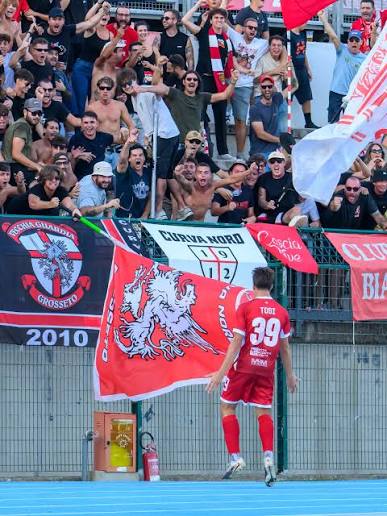
Richard Hall continues this exclusive series for the Gentleman Ultra taking a deep dive into some of Italian football’s sleeping giants and lesser known gems. From history, nostalgia and legendary past players, to everything the modern football groundhopper needs to know, this is the Gentleman Ultra’s Alternative Guide to Grosetto.
There are some football clubs that are defined by what they have won and others by what they nearly achieved. Grosseto belong firmly in the latter category. Tucked away in southern Tuscany, between the Tyrrhenian Sea and the rolling landscape of the Maremma, Stadio Carlo Zecchini is not the San Siro or the Olimpico, nor can Grosseto be compared to one of the great footballing cities of the North. It is quieter than that. This is a provincial city surrounded by medieval walls, farmland and coastline, where football has spent most of its existence away from the glare of Serie A. That, however, is precisely the attraction.
For a brief period in the late 2000s, the “Grifone” threatened to gatecrash Italian football’s top table. They had an ambitious president, a stadium that suddenly found itself hosting Serie B football and, eventually, one of the most unpredictable strikers of his generation. They never quite made Serie A. Perhaps it is better that way. Grosseto remains one of those wonderful Italian football destinations where the story is considerably more interesting than the honours list.
The Club
Grosseto does not immediately feel like a football town. This is Tuscany, but not necessarily the Tuscany sold on postcards of Florence, Siena and Pisa. Grosseto sits further south, capital of the Maremma, only a short journey from the Mediterranean. The old centre remains enclosed by the remarkable Medici walls and life inside them moves at a pace that can seem entirely incompatible with the hysteria of Italian football. Then matchday arrives.

Unione Sportiva Grosseto dates back to 1912 and for much of their existence they operated in the lower reaches of the Italian pyramid. Serie C, Serie D and regional football provided the backdrop to much of the club’s history. Their symbol is the Griffin and the traditional colours are red and white. The Griffin appears on the city’s coat of arms carrying a sword and, when incorporated into the football club’s identity, gives the provincial Grifone rather more menace than their historical record might suggest.
The defining modern period arrived under president Piero Camilli. Grosseto won promotion to Serie B for the first time in 2007 and suddenly found themselves playing clubs whose histories seemed to belong to another world. Their first season was difficult at the beginning, but the appointment of a young Stefano Pioli helped steady the club. Long before he would win the Scudetto with Milan, Pioli was attempting to establish Grosseto in Italy’s second tier. They survived comfortably and even recorded a memorable 3-0 victory over Bologna.
Then things became interesting. In 2008/09, under Elio Gustinetti, Grosseto reached the promotion play-offs. For a club that had never played in Serie A, the impossible suddenly seemed within touching distance. Livorno stood between them and the play-off final and Grosseto won the first leg 2-0 at the Zecchini. They were 90 minutes away from taking another enormous step towards Serie A.
The return at Livorno’s Stadio Armando Picchi descended into chaos. Grosseto lost 4-1 and finished the match with only seven men after four players were sent off. Livorno progressed and would eventually win promotion. For Grosseto, the door to Serie A had opened just enough for them to see what was on the other side before it slammed shut. They have never been that close again.
The Ground – Stadio Carlo Zecchini
If you like modern football grounds, Stadio Carlo Zecchini may initially appear an odd recommendation. If you like Italian football grounds, it is magnificent. The stadium is an architectural reminder of a different age: open, slightly faded and dominated by an athletics track that pushes the supporters away from the pitch. There are no luxury surroundings and little attempt to manufacture an atmosphere. It simply exists as football grounds used to.

Its history stretches considerably further back than Grosseto’s Serie B adventure. The stadium was inaugurated in the early 1950s and later became an Olympic venue when Rome hosted the Games in 1960. Grosseto staged three matches during the Olympic football tournament, a remarkable historical footnote for a relatively small Tuscan city. Originally known as the Stadio Olimpico Comunale, it was eventually renamed after Carlo Zecchini, one of the important figures in Grosseto’s footballing history.
The design immediately distinguishes it from the increasingly uniform modern stadium. There is a covered central grandstand, the open gradinata opposite and curves behind the goals, all separated from the pitch by the athletics track. Behind everything sit the low-rise buildings, trees and open Tuscan skies. It feels unmistakably Italian and, importantly, it still feels like Grosseto rather than a generic modern arena that could have been constructed anywhere in Europe.
When Grosseto reached Serie B in 2007, the stadium suddenly had to adapt to the demands of professional football at a much higher level. Dressing rooms were refurbished, the pitch was relaid and security and access were improved, while temporary structures increased capacity. Yet the work never removed the Zecchini’s character. It still looked like an old provincial Italian stadium that had unexpectedly found itself hosting Serie B football, which in many ways was exactly what it was.
Perhaps the most appealing thing about the Zecchini is its scale. During Grosseto’s best years it could accommodate around 10,000 spectators. This was never going to resemble the Olimpico, San Siro or the larger provincial stadiums of Italy, and that was the point. When Torino arrived for the opening game of the 2009/10 season, there were fewer than 6,000 spectators inside. In purely numerical terms it was modest. Inside the Zecchini, with the running track, old grandstand, red-and-white banners and noise drifting across the open stadium, it did not feel that way.
The Zecchini has also lived a life beyond football. Major athletics meetings have been staged here and Pietro Mennea is among the great Italian athletes to have competed on its track. The stadium has hosted concerts and community events and remains woven into the sporting identity of the city. There are grander stadiums in Italy and certainly more intimidating ones, but few encapsulate provincial Italian football quite as neatly as the Carlo Zecchini.
The Ultras
The heart of the Grosseto support has traditionally been the Curva Nord. Like the club itself, the organised support has a history considerably richer than its relatively small numbers might suggest. The ultras movement in Grosseto began establishing itself during the late 1970s before the Eagles emerged in 1981. They became the first significant organised group and followed the Grifone through the anonymous lower-league grounds that constituted much of the club’s existence.
The Boys followed in 1989 and Brigata Pacciani in 1993. During the late 1990s, supporters from those different traditions came together under the banner Ultras Grosseto Curva Nord, while other groups would subsequently appear around the Curva. This was never a support capable of competing numerically with those in Rome, Milan, Genoa or Naples, but judging Italian ultra culture purely by numbers rather misses the point.

In many ways, the ultras of provincial clubs represent one of the most interesting elements of the Italian game. Following one of the country’s giants around Europe is one experience; travelling around Serie C and Serie D following Grosseto is something completely different. There is an obstinacy to provincial support. The Curva remained when the Serie B adventure disappeared, when the crowds diminished and when the dream of Serie A became increasingly distant.
The club’s rivalries are also shaped by geography. Siena became one of the principal enemies, with an antagonism that extended beyond football and drew on the complicated relationship between the Tuscan cities. Livorno inevitably became another significant fixture, particularly after the extraordinary events of the 2009 promotion play-off. For the visiting groundhopper, the Curva Nord remains important because without it the Zecchini’s open architecture and athletics track could easily swallow the atmosphere. The flags, banners and persistent chanting pull the stadium back together.
This is not one of Italy’s enormous Curvas and it does not need to be. It represents something equally important about Italian football: a relatively small group of supporters stubbornly preserving the identity of their club through promotions, relegations, ownership changes and years spent outside the national spotlight.
The Classic Player – Mauricio Pinilla
Mauricio Pinilla should never really have ended up at Grosseto. That is exactly why he belongs here.
By the time the Chilean arrived in Tuscany in 2009, his career already resembled somebody continually pressing the random button on a football computer game. Universidad de Chile, Inter, Chievo, Celta Vigo, Sporting CP, Racing Santander, Hearts, Vasco da Gama and Apollon Limassol had all featured in his journey, and yet he was still only in his mid-twenties.
Inter had brought him to Italy in 2003 but he never made a competitive appearance for the Nerazzurri. There had been flashes of obvious ability elsewhere, but injuries and inconsistency meant the promise was never converted into anything permanent. By 2009, the question was no longer whether Pinilla possessed talent. Everybody knew that he did. The question was whether anybody would ever see it consistently.
Then came Grosseto.

There was something wonderfully illogical about the relationship: a quiet Tuscan city and one of South American football’s great nomads, a provincial Serie B club and a striker whose career had already taken him across Europe and South America. It should not have worked. Instead, for one season, it worked almost perfectly.
Pinilla started scoring early in the campaign but there were still periods when familiar questions resurfaced. Was this going to be another brief flash before the next transfer, injury or disappearance? Then the goals began arriving with extraordinary regularity and Grosseto suddenly possessed one of the most dangerous forwards in Serie B.
The defining afternoon came in Brescia. Pinilla collected the ball deep inside his own half and drove forward, leaving players behind him before unleashing an extraordinary effort from distance. Later in the first half he struck again, this time moving towards the right side of the penalty area before smashing another vicious shot beyond the goalkeeper. Grosseto won 3-2 and for those few minutes Pinilla looked like the player everybody had always suspected existed somewhere beneath the chaos.
He finished the campaign with the extraordinary record of 24 league goals in just 24 appearances. Grosseto finished seventh and narrowly missed the play-offs, but Pinilla’s rehabilitation was complete. Palermo came calling and Serie A finally received the version of Mauricio Pinilla that had been promised for so long.
His later career would take him to Cagliari, Genoa and Atalanta, while he became far better known internationally with Chile, but there is something fitting about remembering him at Grosseto. Football careers are rarely linear and Pinilla’s looked as though somebody had dropped a plate of spaghetti onto a map of the world. Yet for one extraordinary year everything straightened out.
Twenty-four appearances and 24 goals. Mauricio Pinilla had finally found somewhere to call home. Naturally, he left.
For more on that remarkable season, check out Season Of Their Life: Mauricio Pinilla 2009/10 by @richhall80
The Classic Kit – 2009/10
Sometimes a classic kit becomes iconic because trophies were won in it. Sometimes it is remembered because a great player wore it. Occasionally, a shirt captures a particular club, player and moment so perfectly that the three become almost impossible to separate. Grosseto’s 2009/10 shirt does exactly that.
Manufactured by Erreà, the kit was predominantly red with white detailing and, most importantly, a bold white diagonal sash cutting across the body. The ILCO sponsor sat prominently across the front, while the Griffin maintained the connection with both club and city. It was simple, unusual and unmistakably Italian.
The sash transformed it. Italian shirts of the period could sometimes be overly complicated, but Grosseto’s was not. Red, white, a strong central motif and the Griffin were enough. There was also something faintly South American about it, which made Mauricio Pinilla the perfect player to wear it.
Shaven-headed, aggressive and unpredictable, the Chilean somehow made the shirt look even better. It is now difficult to separate that Grosseto kit from his season. Look at Pinilla wearing the red shirt and white sash and you are immediately transported back to Serie B in 2009/10. That is what a classic football shirt should do. It should not simply remind you of a team; it should remind you of a time.
For Grosseto, it recalls perhaps the most romantic period in their modern history: Serie B, the Zecchini, a provincial Tuscan club still dreaming of Serie A and a Chilean centre-forward scoring virtually every time he walked onto the pitch.
There have been other Grosseto shirts and there have been more modern ones. None carries quite the same story.
The City
Nobody needs convincing to visit Florence, Rome or Milan. Grosseto requires a little more imagination, and that is part of its charm. The historic centre sits inside the hexagonal Medici walls and is compact enough to explore on foot. Piazza Dante forms its centre, with the cathedral nearby, while the wider Maremma offers an entirely different version of Tuscany to the heavily travelled route through Florence, Pisa and Siena.
The sea is also close. Marina di Grosseto sits on the Tyrrhenian coast and the surrounding landscape gives the city the slightly detached feeling that has always characterised its football club. This is not one of the great centres of calcio and nobody would pretend otherwise. It is somewhere football exists alongside everyday life rather than dominating it.
The Stadio Carlo Zecchini is close enough to the centre that there is no need to turn the football into a military operation involving three Metro lines and a bus. Walk through the city, have a coffee, explore the old centre and then head towards the floodlights. That is how Italian football should occasionally be consumed.
You will not see Serie A. You will not find 70,000 people and you may not recognise many of the players. What you will find is a Griffin on the shirts, an old Olympic stadium, a Curva that has survived the club’s rises and falls and a football team representing a part of Tuscany most visitors simply pass through on their way somewhere else.
Somewhere around the Zecchini there also remains the memory of that extraordinary season when Mauricio Pinilla arrived in town. Twenty-four appearances, 24 goals and that red shirt with its white sash. For one brief and glorious period, sleepy Grosseto had one of the most dangerous centre-forwards in Italian football.
That alone makes it worth the journey.
Words by Richard Hall