
Mark Gordon, author of Roberto Baggio, the World Cup Years, kickstarts a legendary series for the Gentleman Ultra taking a deep dive into some of Italian football’s sleeping giants and lesser known gems. From history, nostalgia and legendary past players, to everything the modern football groundhopper needs to know, this is the Gentleman Ultra’s Alternative Guide to Pro Vercelli.
Pro Vercelli: The Forgotten Kings of Italian Football
The name of Pro Vercelli does not come readily to mind when thinking of Italy’s biggest football clubs. Currently playing their football in Serie C, the club has been out of the Italian top flight for close to a century. Despite enduring over 90-years outside Serie A, Pro Vercelli still sits in seventh place when it comes to all-time Serie A winners.
Pro Vercelli were Italian champions seven times between 1908 and 1922. Only Genoa, Milan, Inter and Juventus have lifted the Serie A title more times, with Torino and Bologna both matching the Serie C side’s seven Serie A titles. The first five titles won by Le Bianche Casacche (The White Shirts) came in a remarkable six-year period. There is every chance they would have won six-out-of-six if not for the fact they were taking part in a military tournament in 1910. The Pro Vercelli president of the time, Luigi Bozino, had requested the postponement of the season’s final game against Inter due to the competitions clashing. When the request to delay the game to a later date was denied, Bozino sent a team of 11-year-old schoolboys to represent the club as a protest.
The club slowly dropped through the leagues after winning their final scudetto in the 1921-22 season. They fell as low as Serie D before eventually climbing back to Serie B as recently as the 2017-18, but their relegation at the end of that campaign has seen them reside in the third tier of Italian football ever since.
For more on the origins and history of Pro Vercelli, check out The Timeless Elegance of Pro Vercelli by @richhall80

The Stadium
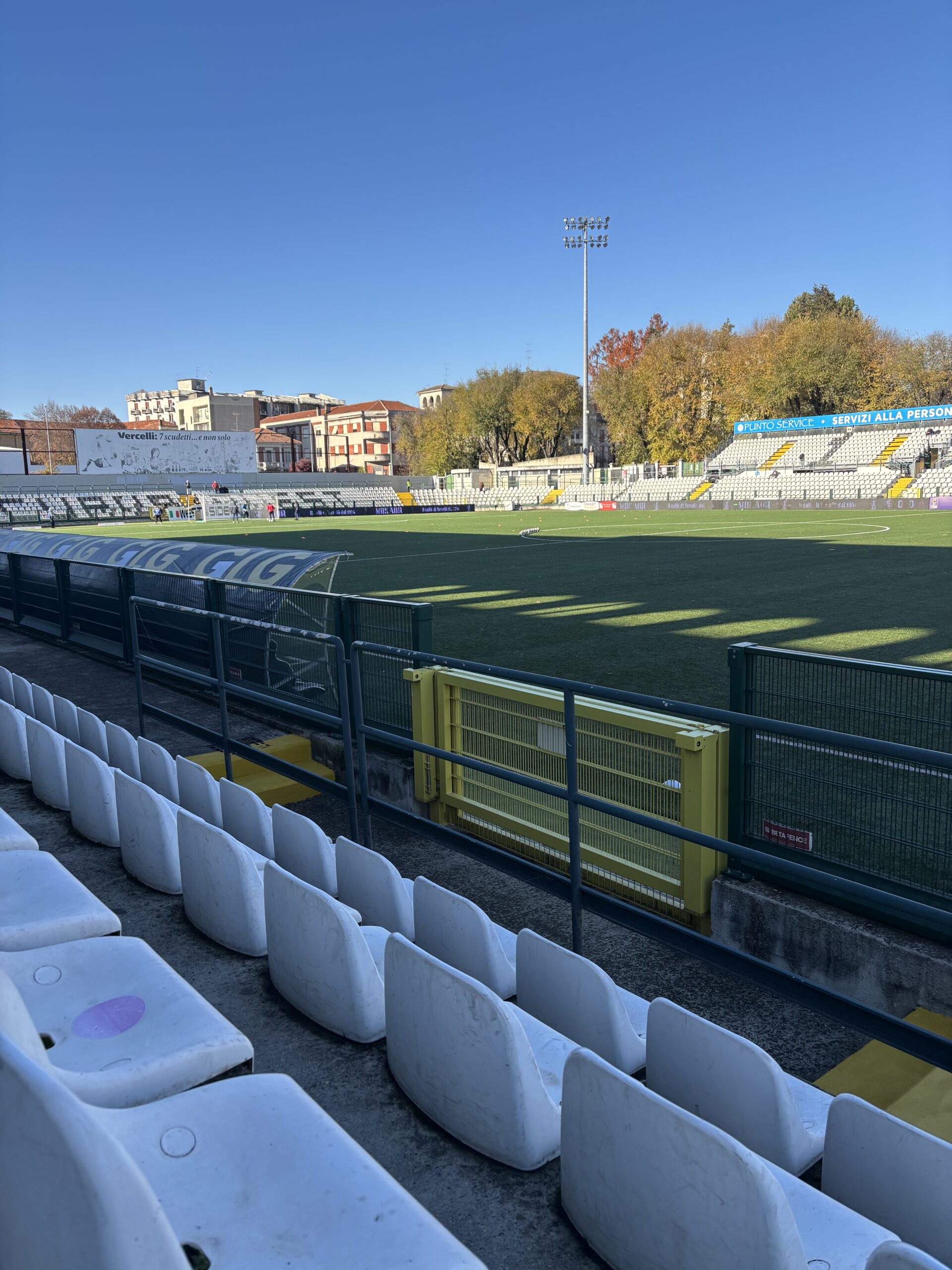
The city of Vercelli is situated in the Piedmont district in the north of Italy, about 55-miles east of Milan. Stadio Silvio Piola is the 5,500 capacity ground which Pro Vercelli call home. A short walk from the train station through a leafy neighbourhood takes you to the ground which is surrounded by residential buildings and a small public park.
The main stand of the stadium has seven shields hanging from the roof representing the club’s historic seven title wins. There is a plaque on the wall outside the ground in tribute to legendary player Silvio Piola, after whom the stadium is named. Despite the ground being part of Italian football history, it has been updated considerably over the years. New seating has been installed throughout and a high quality artificial playing surface has also been laid.
A modest in number but vociferous group of ultras take their place in the curva behind the goal to the left of the main stand. They provide a constant soundtrack of songs whilst their flags bring the section to life, giving the impression that here are far more fans in the ground than there are.

Legendary Player
Pro Vercelli’s Silvio Piola legendary striker began his career in Vercelli, debuting in the top-flight whilst still a teenager. He broke records including becoming the youngest player to score a top-flight hat-trick after netting three times in a game against Napoli. He also scored six goals in one match against Fiorentina, a tally for one game which has still not been surpassed. Pioli remains the second youngest player to score 100 Serie A goals, achieving that feat at the tender age of 23 years and 68 days. Giuseppe Meazza holds all-time record, hitting his century just 36 days younger that Piola.
The striker left Pro Vercelli after five seasons, moving on to Lazio where he would establish himself as one of the world’s best strikers. He also had spells at Torino, Novara and Juventus, but perhaps his crowning glory came in the blue of the Italian national team. He played 34-times for the Azzurri, a tally that would have been far greater if not for the outbreak of the Second World War. Piola scored twice in the 1938 World Cup final as Italy defeated Hungary 4-2 to become World Champions. He later captained his country and ended his international career with 30 goals in 34 appearances.

Visiting Pro Vercelli
Vercelli is well serviced by trains from the larger hubs of Turin and Milan. I travelled from Milan and a ticket for the journey, which lasted around an hour, came in at just over €7. The Stadio Silvio Piola is a short walk from the train station making the ground easy to locate. I bought a ticket for the match from the club website using Vivaticket. I paid around €23 for my ticket for a Serie C game against Alcione Milano.
Pro Vercelli is well worth the visit to sample some Italian football history and its location makes it very easy to factor in if you are planning a groundhopping trip to Milan.
Words by Mark Gordon, author of Roberto Baggio, the World Cup Years.