
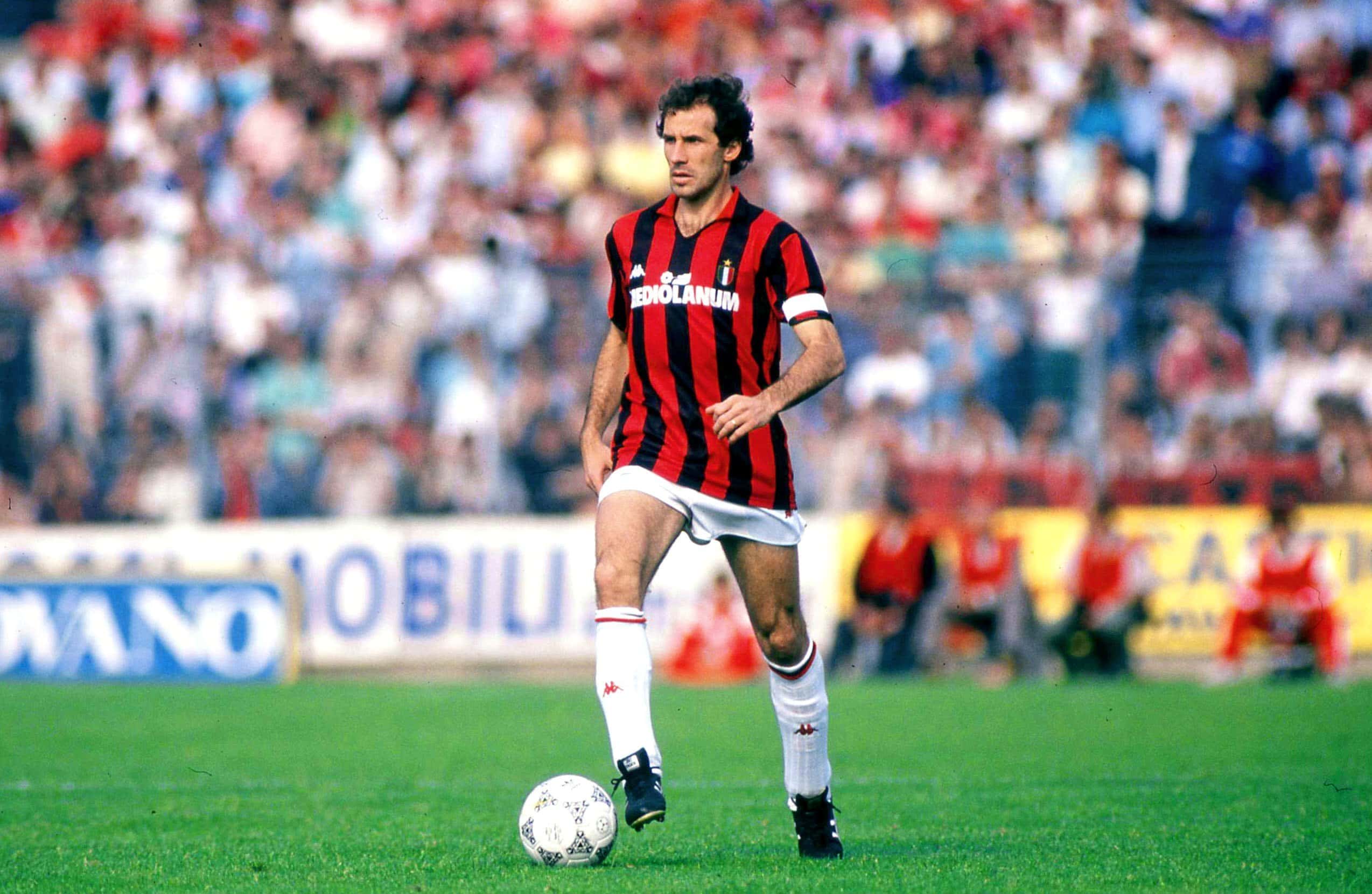
Rich Hall pays tribute to the Milan and Italy legend Franco Baresi, who has died aged 66.
There is a heavy, shimmering heat that hangs over San Siro when the Milanese summer reaches its peak in July. The concrete arches of the Meazza bake under the relentless sun, casting sharp, dark shadows across the empty piazza where thousands usually gather. But today, the summer heat gives way to a sudden, collective chill. Today, Italian football loses not just one of its greatest sons, but the very architectural blueprint of defending itself.
Franco Baresi has passed away.
To those who grew up watching Channel 4’s Football Italia on cold Saturday mornings in the UK, or to those who spent their holidays devouring the pink pages of La Gazzetta dello Sport on a sun-drenched terrace, Baresi was more than a footballer. He was a mythical figure who seemed to belong to an older, nobler era of Calcio. While the modern game obsesses over physical behemoths and sprinting full-backs, Baresi stood at a modest 5ft 9in. Yet, when he stepped onto the pitch wearing the captain’s armband of AC Milan or the Azzurro of Italy, he looked ten feet tall.
He was, quite simply, Il Capitano.
Born in Travagliato in 1960, Baresi’s journey was forged in tragedy and grit. Having lost both of his parents by the age of sixteen, football was not merely a career—it was his sanctuary. Rejected by Inter as a youngster (who famously took his brother, Beppe, instead), Franco found his home on the red-and-black side of the city. It was a decision that would alter the course of European football history.
To watch Baresi defend was to watch a master craftsman at work. He did not tackle out of desperation; he tackled out of absolute certainty. He read the game three moves ahead of everyone else on the pitch. While a forward was still processing a pass, Baresi had already intercepted the ball, adjusted his body, and begun stroking it forward with that effortless, chest-out elegance that became his trademark.
He was the beating heart of Arrigo Sacchi’s revolution in the late 1980s. Alongside Paolo Maldini, Alessandro Costacurta, and Mauro Tassotti, Baresi anchored the most formidable defensive line the world has ever seen. Sacchi brought high-pressing, zonal tactical orthodoxy to Italy, but it was Baresi who executed it on the pitch. With his arm raised in unison with the referee’s whistle, he marshalled a high line with military precision, catching the world’s best strikers in his lethal offside trap.
Yet, for all his tactical intellect, Baresi was defined by a ruthless, unyielding bravery.
Nothing encapsulated the spirit of Franco Baresi more than the 1994 World Cup in the sweltering heat of the United States. In Italy’s second group match against Norway, Baresi tore his meniscus. For almost any other athlete on the planet, the tournament was over. He underwent keyhole surgery in New York, missed three weeks of football, and somehow—through pure, agonising strength of will—returned 25 days later to play the Final against Brazil under the punishing summer sun of Pasadena.
For 120 minutes, operating on a single good knee, Baresi put on a defensive masterclass for the ages. He silenced Romário and Bebeto, winning every header, intercepting every pass, throwing his body into every block. When the match drifted to the cruelty of a penalty shootout and his exhausted body finally gave out, forcing his spot-kick over the bar, the image of Baresi weeping openly in his shirt broke hearts from Milan to Manchester. It was a reminder that behind the invincible libero was a man who gave every ounce of his soul to his country.
When he finally retired in 1997 after 719 appearances for Milan, the club did something unprecedented in Italian football: they retired his Number 6 shirt. It was a gesture of respect reserved only for the divine.
In an era of commercialisation, loyalty in football is often treated as a relic of the past. But Franco Baresi spent 20 years wearing one shirt, remaining with Milan even through the dark days of Serie B in the early 1980s, refusing to abandon ship when the storm was at its fiercest. He earned his glory the hard way.
For those of us who have spent a lifetime writing about, obsessing over, and loving the romance of Italian football, Baresi represented the very soul of the game. He proved that grace and grit can coexist on the same pitch, and that defending, at its highest level, is an art form worthy of the Uffizi.
The Number 6 has hung in the rafters of San Siro for nearly three decades, but today, as the late afternoon light fades over the Lombardy plains, Il Capitano takes his final walk down the tunnel. The pitch at the Meazza will never quite feel the same again.
Riposa in pace, Franco. Grazie di tutto.