
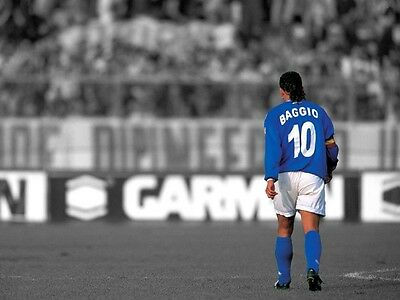
As a child of the eighties, it’s fair to say that my nostalgia for Italian football peaked in the summer of 1990. For me, Italia 90 was “the best World Cup ever”. Gascoigne and Milla, Pavarotti and New Order, and, of course, Totò Schillaci.
It might have had something to do with that ridiculous ponytail or that fussily manicured goatee, but Roberto Baggio was never really my cup of tea. Besides, by the early 1990s, just as Baggio was reaching his prime, I was entering my teenage years, and had other distractions.
That’s why I was intrigued to pick up a copy of Mark Gordon’s new book, Roberto Baggio, The World Cup Years. Despite my reservations, my interest in Baggio had been piqued by the 2021 biographical film directed by Letizia Lamartire and starring Andrea Arcangeli as the legendary Italian number 10. Perhaps I’d misunderstood him all along. After all, in the era of Maradona et al, Baggio was the most expensive football player in the world.
In terms of Italian football nostalgia, Mark Gordon’s account picks up more or less where Verona Campione, The Miracle of 85 concludes. In the 1984/85 season, a 17-year-old Roberto Baggio was enjoying his final season with Vicenza in Serie C1. He scored 12 goals in 29 appearances and won the Guerin d’Oro, as his childhood club earned promotion to Serie B. It was the kind of the form that was attracting interest from some of the big beasts of Italian football.

At the tail end of that season, however, Baggio suffered a catastrophic knee injury (the first of many that would plague his career). At barely 18 years old, his fledgling career as a professional footballer hung by a tendon. Despite the injury, Fiorentina proceeded with the £1.5m transfer. It would be over a year before Baggio made his Serie A debut in a 2-0 home win against Sampdoria before suffering another serious knee injury that would keep him out of action for another season.
Despite the setbacks, Baggio would go on to become a Fiorentina legend, scoring 55 goals in 136 appearances before being sold in 1990 to Juventus, one of La Viola’s fiercest rivals. It is at this point that Mark Gordon’s book really kicks off.
While the focus of The World Cup Years is clearly Baggio’s experience with the national team, in between the blow-by-blow accounts of each World Cup, Gordon provides the necessary context of the trials and tribulations of Baggio’s domestic career. His relationships with the various coaches he encountered, the injuries that ravaged his body, the idiosyncratic transfer decisions that were a hallmark of his career.
Baggio would score 27 goals in 56 appearances for the Italian national team, a tally that might seem paltry compared to the current crop of footballing phenomena. But it is a record that puts him in fourth place on the Italian all-time list (alongside his successor at Juve, Alessandro Del Piero, who reached the same tally in 91 appearances). Nor was there any shortage of attacking options in the 1990s, with the likes of Schillaci, Vialli, Zola, Ravanelli, Vieri, Inzaghi and Chiesa all competing with Baggio for a starting place in the national team at one point or another.
Verona’s Stadio Marcantonio Bentegodi even makes a cameo appearance as the site of Baggio’s first goal for the Azzuri in a 1-1 draw against Uruguay in an international friendly. The Bentegodi would, of course, go on to become a proud World Cup venue just a few months later.
Though overshadowed by his more prolific strike partner at Italia 90, Baggio would score what was widely regarded as the goal of the tournament in Italy’s final group match against Czechoslovakia. It was a goal, as Mark Gordon explains, that would come to mark the arrival of “a special player” on the global scene and be remembered as “one of the greatest World Cup goals ever scored”.
So, am I a convert? Has Mark Gordon convinced me?
Well, I certainly have a greater appreciation for the hurdles that Baggio had to overcome throughout his career. Not just the injuries, which were catastrophic, but also the often-fractious nature of the relationships with his managers for both club and country. Nearly all the coaches he worked with seemed to undervalue him, to consider him a luxury. He spent months, sometimes years, on the sidelines or plying his trade with unfashionable clubs like Bologna and Brescia.
Despite this, Baggio is undoubtedly one of Italy’s greatest players. His World Cup record speaks for itself. But.
He never won the World Cup. The furthest he reached was that memorable 1990 semi-final against Maradona’s Argentina at the San Paolo. In that game Baggio came on as a second half substitute contributing a goal in the penalty shoot-out that Italy would go on to lose thanks to an Aldo Serena miss. Perhaps, if Baggio had played 90 minutes, Italy would have won that game. Perhaps. I guess we’ll never know.
Baggio’s second attempt at World Cup glory was in the in USA 1994. By now the world’s most expensive player, captain of Juventus and European and World Player of the Year, his first game ended in an ignominious 1-0 defeat against the Republic of Ireland. The second game against Norway wasn’t much better for Baggio who was withdrawn when Italy were reduced to ten men. Despite the numerical deficit, Italy held on for a narrow 1-0 victory to get their campaign back on track. Baggio returned to the starting line-up against Mexico, but it was another underwhelming Italian performance that ended in a 1-1 draw as Italy scraped through from the group. In the round of 16, Baggio scored both goals as Italy overcame Nigeria deep in extra time with two pieces of individual brilliance. He came to the rescue again in the quarter-final with a last-minute winner against Spain but, as Gordon concedes, he had contributed very little as the game neared its closing stages.
Italy overcame Bulgaria, tournament dark horses, in the semi-final thanks to two Baggio goals in the space of five minutes, taking them to the brink of the World Cup Final, but the game ended on a sour note as he hobbled off deep in the second half. Baggio had produced what Gordon describes as “one of the most memorable performances in Italian history” but he left the field in tears as he contemplated missing out on a final against Brazil through injury.
If you don’t know what happened in that dramatic final, then I would urge you to pick up a copy of Mark Gordon’s book (no spoilers here).
Fairly or not, it’s an episode that would define Roberto Baggio’s entire playing career.
By the time France 98 comes around, one has the sense that Baggio is on his last legs after years of injury and rough treatment at the hands of cynical opponents. Despite that, he forms a promising partnership with Cristian Vieri and lays some of the ghosts of USA 94 to rest, becoming the first Italian player to score in three World Cups in the process. This is clearly not a vintage Italian team, however, and one gets the impression that this is a story that is petering out without ever reaching a climax.
At France 98, Baggio joins Paolo Rossi as Italy’s all-time top goalscorer at the World Cup with his match-winning goal against Austria, but he spent more time on the bench than he would have wanted. Italy eventually succumb to Zinedine Zidane’s France on penalties in the quarter-final. Baggio made an appearance from the bench with twenty minutes remaining and came close to snatching a winner as the spectre of another dramatic penalty shoot-out once again loomed large. There was no mistake from Baggio this time, but when Luigi Di Biagio smashed his spot kick off the crossbar, Italy’s dream was over.
Despite a miraculous effort to prove his fitness after yet another serious injury and a promise that Giovanni Trapattoni would include him in his squad if he was fit, the 2002 World Cup proved a bridge to far even for Baggio. The Brescia player was omitted from the squad that travelled to Japan and South Korea. For Baggio it was another bitter blow in a career that brought so much joy but that was so often tinged with the pain of injury or defeat.
Roberto Baggio, The World Cup Years is published by Pitch Publishing and is available at: https://www.pitchpublishing.co.uk/shop/roberto-baggio
Richard Hough is the author of Verona Campione, The Miracle of 85.
