
Our previous article on the golden age of Calcio introduced why we all thought it was so cool, but there was once a time when the cult teams ruled this world full of superstars and giants. In England we’ve always loved the underdog story, the David against the Goliath, it’s why the FA Cup holds such a fond place in our hearts. So when we see the provincial uprisings in Italy, it captures the imagination in England.
That’s why the cult teams matter, not the serial winners in Milan or Turin, not the industrious might from the large city clubs but the sides who bent the power structure in Italy – the disruptors.
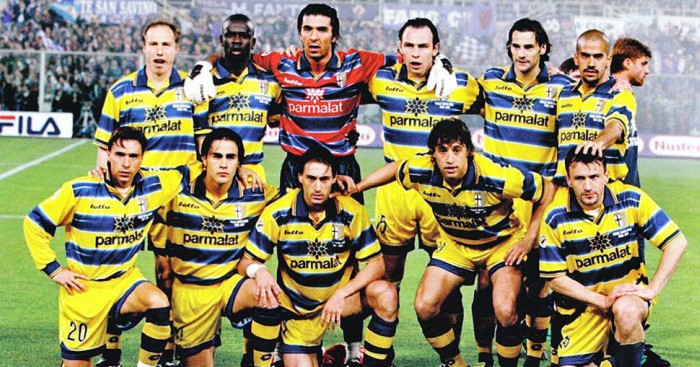
Subsequent articles will tell their full stories the way they deserve to be told, but this feature will introduce us to some of the cult teams that encapsulated the romance of 90s Calcio. Vicenza lifting a Coppa Italia and nearly conquering Europe. Sampdoria’s twin geniuses painting Wembley blue and white. Parma assembling a Football Manager fever dream in the shadow of a dairy empire. Fiorentina orbiting Batistuta’s left foot like believers in a cathedral.
They burned brightly, often briefly. And maybe that’s the point. These cult sides remind us that Serie A’s golden era wasn’t only about dominance. It was about possibility.
And possibility, in football, is the most addictive drug of all.
Vicenza

If there was ever a romantic underdog in 90s Serie A, it was Vicenza Calcio. A provincial club from Veneto, they returned to Serie A in 1995 and within two seasons produced one of the most improbable stories of the decade.
Under the quietly brilliant Francesco Guidolin, Vicenza blended tactical discipline with fearless attacking play. The 1996/97 season remains immortal: they won the Coppa Italia — defeating Napoli in the final — and reached the semi-finals of the Cup Winners’ Cup the following year, narrowly losing to Chelsea after extra time at Stamford Bridge.
Their side wasn’t packed with global icons, but cult heroes: striker Pasquale Luiso (nicknamed “Il Toro di Sora”), a young Luca Toni emerging, and clever midfield technicians who embodied that compact, tactical Serie A aesthetic.
Vicenza were never meant to crash the elite party — which is precisely why everyone remembers them. They represented a time when provincial Italy could still dream big.
Sampdoria

Before financial implosion and yo-yo seasons, Sampdoria were arguably the coolest team in Europe.
Their 1990/91 Scudetto under Vujadin Boškov felt like football romanticism beating industrial power. The twin genius of Roberto Mancini and Gianluca Vialli — “I Gemelli del Gol” — gave them artistry and edge. Add Gianluca Pagliuca in goal and Pietro Vierchowod in defence and you had a side that was balanced, elegant and streetwise.
In 1992 they reached the European Cup final at Wembley, losing narrowly to Barcelona in extra time. It felt like the peak of Italian club dominance.
But the cult aura comes from what followed: key departures, financial strain, and gradual decline through the mid-to-late 90s. Sampdoria went from champions of Italy to relegated by 1999. That rise-and-fall arc — beautiful, brief, slightly tragic — is pure 90s Calcio drama.
Parma

If Samp were romantic, Parma were the modern project before modern projects existed.
Fuelled by Parmalat money under President Calisto Tanzi, Parma built a squad that felt like Football Manager fantasy made real. By the late 90s they boasted Gianluigi Buffon, Fabio Cannavaro, Lilian Thuram, Juan Sebastián Verón and Hernán Crespo — a spine that could compete with anyone in Europe.
They won the UEFA Cup in 1995 and again in 1999, alongside multiple Coppa Italia triumphs. The 1998/99 season, finishing 4th in Serie A and lifting the UEFA Cup and Coppa Italia, felt like their zenith.
Yet Parma’s cult status is tied to the bubble bursting. The Parmalat scandal in the early 2000s dismantled the project. What remains is a snapshot of late-90s excess: glamorous kits, outrageous talent, and the sense that Serie A was football’s centre of gravity.
Fiorentina

No cult list is complete without ACF Fiorentina in the late 90s.
They revolved around one man: Gabriel Batistuta. Batigol wasn’t just prolific; he felt mythic. Paired with Rui Costa’s silk in midfield, Fiorentina briefly looked like Scudetto challengers in 1998/99 before fading in the second half of the season.
Their purple kits, the art-deco Stadio Artemio Franchi, and the dramatic Florentine backdrop added aesthetic weight. Financial collapse in 2002 would eventually send them into bankruptcy and rebirth — another classic Calcio boom-and-bust narrative.
Fiorentina symbolised the emotional intensity of the era: devotion to a talisman, flashes of brilliance, and the ever-present fragility beneath the glamour.
So this is where we begin — not with the giants who owned the era, but with the sides who coloured it in. The provincial dreamers, the bankrolled revolutionaries, the beautiful nearly-men and the one-season wonders who made Serie A feel like a league where anything might happen.
In the weeks ahead, we’ll slow the tape down properly: Vicenza’s impossible cup run, Sampdoria’s rise and unraveling, Parma’s Parmalat-powered ascent, Fiorentina’s Batistuta cathedral, and the other cult chapters that deserve their own spotlight.
Because these teams weren’t footnotes to the golden age — they were its texture. And if the 90s taught us anything, it’s that sometimes the stories just beneath the summit are the ones that stay with you longest.