
Following Hellas Verona’s relegation to Serie B, Richard Hough, author of Verona Campione, the Miracle of 85, reflects on a historically bad season for the club and asks if the experience of the past can provide any solutions for the future.
For a club like Hellas Verona, relegation is sometimes a necessary evil.
This time around (my third relegation in 15 years living in Verona), it’s a painful but seemingly inevitable corrective realignment after seven consecutive seasons in Serie A.
For much of the current campaign, relegation has just felt inevitable: despite some decent performances, results never seemed to materialise (just two victories in 36 games!) and Hellas have spent much of the season languishing stubbornly in the drop zone.
An early 4-0 defeat against Lazio on Match Day 2 set the tone for what was to follow. A deflating goalless draw at home against newly promoted Cremonese was quickly followed by a Coppa Italia exit on penalties to Serie B upstarts Venezia.
Another early blow came when Tomáš Suslov, one of Verona’s most important offensive players in recent seasons, suffered a serious ACL injury that sidelined him for much of the rest of the season.
All of this before the end of September meant that Verona’s season was over before it ever really got going.
Relegation battle
While impressive performances at home against Inter (a narrow home defeat), Atalanta (a rare victory), Napoli (a point on the road), and Juventus (another shock point on the road), it was the failure to pick up points at home against the likes of Sassuolo, Parma, Udinese and Genoa, while also struggling against fellow relegation contenders Lecce, Pisa and Cremonese, that really sealed the club’s fate this season. After all, Verona’s fortunes are rarely judged against the giants of Milan, Rome and Turin. But, if they are to survive in the top tier, they must compete against fellow mid-level opponents and relegation contenders. In fact, there is no reason why a club of Verona’s stature should not be able to compete at that level.
With a relegation battle looming, the sale of Brazilian striker Giovane to Napoli in January after barely six months in Verona was a clear statement of intent – the club’s priorities were clearly on the balance sheet rather than on the pitch. While you might be able to make a plausible economic argument for selling your greatest assets, that rarely makes sense on the pitch, and for fans, it’s seen as little more than asset stripping.
La festa siamo noi
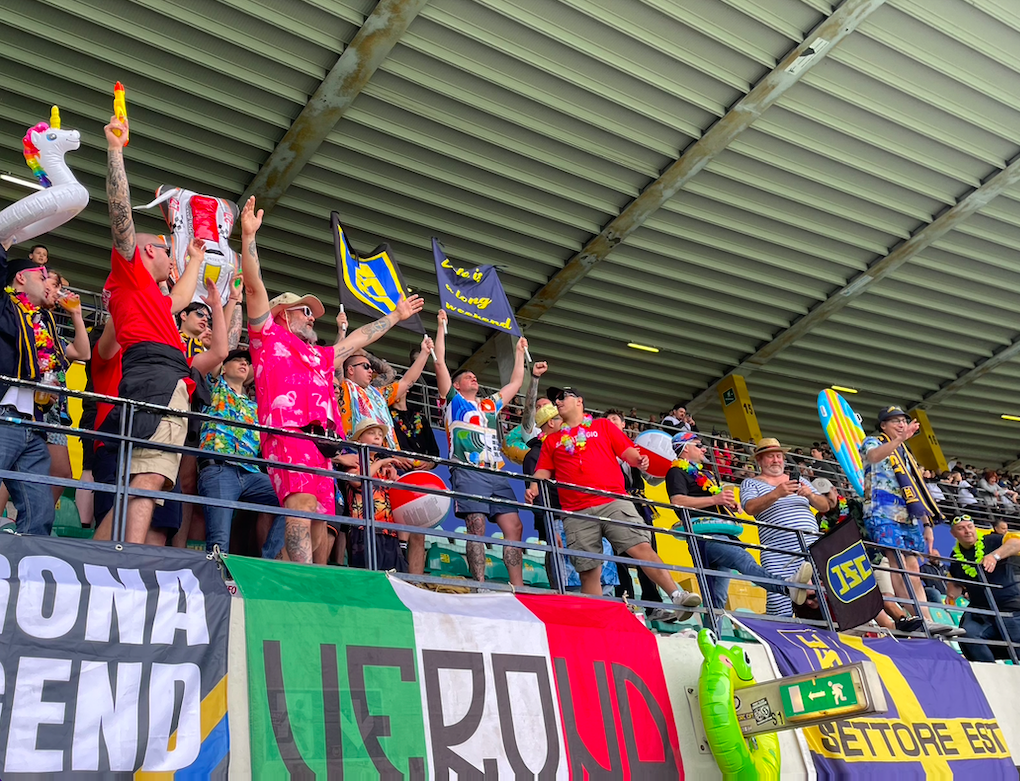
On Sunday against Como at the Bentegodi, Hellas Verona fans embraced their Serie B status with trademark irony, hosting an unruly celebration that proved more entertaining than the match itself. Ultras in the Curva Sud displayed massive letter Bs, while unfurling a banner that read: “Perche la festa siamo noi” [“Because we are the party”], while in the East Stand fans hosted a riotious beach party with inflatables, water pistols and questionable swimwear.

Taking the game too seriously
This was clearly a carefully orchestrated outflanking manoeuvre designed to pre-empt the inevitable ribbing that would come from the Como end. You can’t mock us, was the message from the Curva Sud, we’re taking care of that ourselves.
Of course, the ironic celebrations on Sunday afternoon were also directed at the club’s American owners, Texas-based private equity firm Presidio Investors, who officially completed their takeover of Hellas Verona in January 2025. By ridiculing them and their apparent lack of investment in the club, the fans were expressing their “ownership” of club.
But mainly Sunday was just about having fun.
Sometimes we can take football too seriously, so the beach party in the Poltrone Est on Sunday afternoon was a timely reminder that football is just a game and, in between hurling insults at opposition fans and players and the pain of seeing your team lose, it’s still possible to enjoy yourself on the terraces.
Lesson from the past
So, what went wrong for Hellas Verona this season and can any lessons be drawn from the club’s past?
- The Coach. Osvaldo Bagnoli was a truly exceptional individual with extensive experience as a both a player and a coach. He had a clear footballing philosophy and knew exactly the kind of player he wanted in his team. Like Bagnoli, Paolo Zanetti is an honest and hardworking young coach. His most notable achievement was securing promotion to Serie A via the 2021 play-offs with Venezia. He was then hastily dismissed by Venezia after a poor start to his Serie A career. He was appointed by Verona in June 2024 to succeed Marco Baroni. In his first season he finished in a respectable if uninspiring 14th place. Things never really got going this season and, in January, when Hellas failed to secure a win in eight consecutive matches, including a catastrophic 4-0 defeat away to Cagliari, Zanetti was finally dismissed. The decision to replace him with Paolo Sammarco, a youth team coach with no experience at senior level, was a serious failure of competence, ambition and organisation.
- The Squad. Last summer’s close season involved significant player turnover. Club stalwarts including Davidowicz, Lazović, Faraoni and Duda were released, and the club also cashed in on the emerging talents of Ghilardi and Coppola. In contrast to the Bagnoli era, when a core squad of players was strengthened from one season to the next with the addition of one or two new players each year, there is currently little continuity from one year to the next, with each new season involving a significant rebuilding project.
- Identity. Identity, as I say in Verona Campione, is a frequently under-valued component of a successful football club. A successful team needs a clear footballing identity: a structure, a style of play and a mentality that is instantly recognisable. This is driven by the coach and permeates onto the pitch through the players. Verona has lacked a coherent footballing identity since the dismissal of Igor Tudor in May 2022.
- Ambition. High managerial and player turnover points to a certain lack of ambition at the club. Verona’s two most successful coaches in recent seasons (Ivan Juric and Igor Tudor) both left when the club failed to meet their ambitions in terms of player retention and transfer budget. While both coaches have struggled elsewhere, they achieved impressive results during their respective tenures at Verona and some have even been touting Juric’s possible return in recent days.
- Unity. Unity between players, coaches, fans and boardroom was a striking feature of the Bagnoli-era. From the president down, the players, staff and officials were visible, available and committed to the same project. In the modern era of social media and strained relationships between fans, players and owners, such proximity may no longer be possible. In a rare “public” appearance, after the game against Como the club released a staged interview with Presidio’s Christian Puscasiu that addressed some of the criticism the club has faced in recent months. While it may have appeased some fans, many were left wondering why it had taken so long.
Ultimately, of course, the Bagnoli dream ended in tears. The club had over-extended itself and suffered the ignominy of relegation and financial ruin. There are countless other examples of clubs in Italy that suffered similar fates. So, should we applaud Presidio’s cautious approach to balancing the books?
Football, as every pundit knows, is a results-based business. Appointing the right coach and investing in a squad capable of earning promotion from Serie B should be the over-riding priority for the club right now. Redeveloping the stadium, exploiting commercial opportunities, and even improving the fan experience inside the stadium, as admirable as those objectives are, are all secondary.
That’s why announcing the architect for a new stadium (which sceptics will tell you will never happen) before selecting a coach for the new season is like putting the cart before the horse. Of course the Bentegodi needs upgrading. But that’s no good if the club is languishing in Serie B!
Richard Hough is the author of Verona Campione, the Miracle of 85.
