
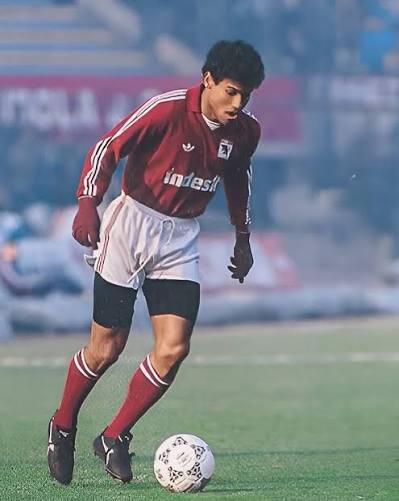
For The Gentleman Ultra’s When Calcio Ruled the World series, Richard Hall unpacks the turbulent tale of Müller—one of Brazil’s most electrifying attacking talents, whose spell in Italy was never straightforward.
There are some footballers who are remembered for the trophies they won, others for the goals they scored and a select few for the feeling they gave you when they had the ball at their feet. Luiz Antônio Corrêa da Costa, better known simply as Müller, belonged to the latter category. At least, that was the case in Turin.
The Brazilian arrived in Italy in 1988, at a time when Serie A had the greatest collection of footballing talent on the planet. Diego Maradona was in Naples, the Dutch revolution was taking shape at Milan, and Inter were preparing to embark on a record-breaking season under Giovanni Trapattoni.
For Torino, however, the story was rather different.
Müller was quick, unpredictable, technically gifted and capable of moments of extraordinary brilliance. He was also about to discover that individual talent, however exceptional, couldn’t always overcome the brutal realities of Italian football.
His time at Torino would see goals, relegation, promotion and, ultimately, an unexpected departure. Years later, there would be a final, almost forgotten, Italian chapter at Perugia.
Torino Lands One of Brazil’s Most Exciting Attacking Talents
When Torino signed Müller from São Paulo in the summer of 1988, they were acquiring one of Brazilian football’s most exciting attacking talents. Still only 22, he had already represented his country at the 1986 World Cup in Mexico and had established himself as a player of considerable promise.
Torino were attempting to rebuild after a frustrating conclusion to the previous campaign. Their supporters had watched the club come agonisingly close to European qualification and reach the Coppa Italia final, only to end in disappointment. Now they wanted something different.
The arrival of Müller, alongside fellow Brazilian Edu and Yugoslav forward Haris Škoro, suggested ambition. Torino were looking to inject flair into a side that needed inspiration, and the Brazilian appeared perfectly suited to the task.
He was not a conventional centre-forward. Müller liked to move across the attacking line, accelerate into spaces and attack defenders directly. He possessed that unmistakable Brazilian ability to make difficult things appear almost effortless. Yet Italy was a different world.
Defenders were ruthless, space was limited and tactical discipline was demanded almost religiously. The romantic notion of a Brazilian attacker arriving in Serie A and entertaining the crowds was one thing; surviving the weekly examination imposed by Italian defenders was quite another.

A Season That Ends in Disaster
The 1988–89 season was a disaster for Torino, although Müller himself produced moments of genuine quality. He scored 11 goals in 31 league appearances, a respectable return for a young foreign forward adapting to the most demanding championship in Europe.
The problem was everything around him. Torino struggled for consistency, confidence disappeared and managerial changes only added to the confusion. Luigi Radice departed, Claudio Sala attempted to rescue the situation and Sergio Vatta was eventually handed an almost impossible task. The final blow came at Lecce, where a 3–1 defeat confirmed relegation.
For Müller, there was a bitter irony. He had demonstrated that he could score against Italian defences, but his goals had not been enough to keep Torino in Serie A.
There were also difficulties away from the pitch. Contemporary Italian reports described complications surrounding a late return from Brazil after the winter break. It was another indication that life in Italy was not always straightforward for the young Brazilian.
Relegation would ordinarily have provided the perfect excuse for an ambitious international to leave. Müller did the opposite.
An Emotional Farewell
He remained with Torino for the 1989–90 Serie B campaign, working under Eugenio Fascetti as the Granata attempted to restore their pride. Once again, he scored 11 league goals, this time in 27 appearances, becoming the club’s leading league goalscorer.
Torino secured promotion, finishing top of Serie B. Their 3–0 victory over Messina in May 1990 marked the return to the top flight and an emotional farewell to the Stadio Comunale.
It was perhaps Müller’s most significant achievement in Italy. Not because Serie B represented the pinnacle of his abilities, but because he had stayed when leaving would have been considerably easier.
Years later, Müller explained that he had become comfortable in Turin, developed friendships, and declined opportunities elsewhere. There was affection for the city, even if his footballing ambitions might have been better served somewhere else.

A World Cup Winner Returns to Italy
The 1990 World Cup briefly returned Müller to the international spotlight. Playing alongside Careca, he scored twice as Brazil progressed through the group stage before their elimination by Argentina.
When Torino returned to Serie A, however, his own Italian adventure was approaching its conclusion. He made just seven league appearances in the 1990–91 campaign, scoring twice, before returning to São Paulo.
Torino would go on to finish fifth under Emiliano Mondonico and qualify for Europe. Müller, meanwhile, would enjoy some of the greatest successes of his career back in Brazil, including continental and world titles with São Paulo.
His Italian league record for Torino amounted to 65 appearances and 24 goals across the two divisions. Not an extraordinary statistical legacy, perhaps, but certainly one that deserves more recognition than it receives.
In January 1997, Müller returned to Italy. Now 30 and a World Cup winner with Brazil in 1994, he was recruited by Luciano Gaucci’s Perugia, managed by Nevio Scala.
The transfer was anything but straightforward. A dispute over his release from São Paulo resulted in prolonged negotiations and legal proceedings. Eventually, an agreement worth $1.7 million was reached.
What followed was remarkably brief. Müller made six Serie A appearances, starting just once and failing to score. Despite his reputation, he struggled to establish himself in Scala’s plans.
Then Santos came calling. Müller later explained that he had enjoyed his time in Perugia and maintained a good relationship with Scala, but he was barely playing. When Santos offered him a return to Brazil, he approached Gaucci about leaving.
The Perugia president agreed. The club was paying substantial wages to a player it was hardly using. There was, however, another complication: the original agreement with São Paulo contained a financial penalty should Müller return to Brazilian football before a specified date. When he joined Santos, São Paulo pursued a claim over the clause.
His second Italian adventure had lasted only a few months, but it represented another complicated chapter in a life that was never straightforward.
What Might Have Been?
Perhaps the greatest frustration about Müller’s Italian career is what might have been. He was a player who could operate across the forward line, score goals and produce moments of invention that defenders simply could not anticipate.
At Torino, he arrived at the wrong moment, joining a club entering a period of turmoil rather than prosperity. At Perugia, he arrived too late, with his best football already behind him and little opportunity to make an impression.
Yet there remains something rather romantic about his decision to stay with Torino after relegation. In an era when Serie A attracted the finest players in the world, Müller could have pursued greater opportunities. Instead, for a time, he chose the Granata.
His name may not be celebrated in Italy alongside those of Maradona, Gullit or Matthäus, but he was part of that extraordinary generation of footballers who made Italian football essential viewing.
Because when calcio ruled the world, not every great player won a Scudetto. Some found themselves fighting relegation, playing in Serie B and leaving behind memories that were far more complicated than the trophies they collected elsewhere. Müller was one of them.
Word by Richard Hall.