
Roberto Mancini
In the first in a new series for the Gentleman Ultra, Mark Gordon charts the highs and lows of Roberto Mancini’s managerial career.
Throughout his playing career, Roberto Mancini displayed the characteristics that would lead him into management. On the pitch he was a technically gifted forward with a propensity for flashes of brilliance. Mancini was also a leader, a hugely influential character with a thoughtful football mind.
At the age of 36, Mancini was player-coach at Lazio working alongside their manager at the time, the late Sven-Goran Eriksson. Despite the opportunity to move into coaching, the fact that the ‘player’ part of his title had become somewhat redundant was a source of frustration for Mancini. He spent six months on the sidelines, as Eriksson chose not to play the former Sampdoria captain, leading him to leave in search of game time in the twilight of his playing career. Few could have predicted his destination, as Mancini chose English football with Leicester City.

Lured to Florence
It would be a short stay in the English game for the former Italy international, as his first foray into management cut short his stay at Leicester after only a handful of games. A bad run of form in Serie A had seen Fiorentina fall from third to tenth place in the table. To make matters worse their manager at the time, Fatih Terim, handed in his resignation so he could take up the managerial role at Milan. Mancini was not an obvious choice to take over from the Turk, not least because he had not attained the relevant coaching badges. That did not stop La Viola from luring Mancini to Florence to take charge of the team.
Mancini arrived at the Artemio Franchi in March 2001 and, by the end of May, he had secured his first trophy as a manager. Fiorentina’s place in the Coppa Italia final had been secured before Mancini took charge but he led them into the two-legged final against Parma. A 1-0 victory away from home in the first-leg was followed by a 1-1 draw in Florence which saw La Viola lift the trophy they had previously won in 1996.
The Coppa Italia victory papered over the cracks at the club, as their financial issues off the field limited Mancini’s impact in his first managerial role. Rui Costa was sold in the summer to raise much needed funds, whilst star striker Enrico Chiesa was ruled out for the season with a knee injury after just five league games. Mancini and Fiorentina parted ways in January of that campaign after a 3-1 home loss to Perugia, which saw the side languishing in 17th position.

Return to Lazio
It was not long before Mancini got himself back in the managerial game, returning to take charge of his former club, Lazio. He immediately faced similar financial issues to those that had hampered him in Florence as Lazio were forced to sell star names such as Alessandro Nesta and Hernan Crespo. Despite the financial restraints he was operating under, Mancini’s first season in the capital was a positive one. Lazio finished fourth, qualifying for the Champions League. They also made it to the semi-final stage of both the UEFA Cup and the Coppa Italia.
His second campaign in Rome saw him lead his side to a Coppa Italia victory as he lifted the trophy as manager for the second time in three seasons. At the end of that campaign Inter identified Mancini as a potential new manager. The Nerazzurri had suffered a poor season in the previous campaign with manager Hector Cuper being sacked mid-season and Alberto Zaccheroni taking over for the remainder of the campaign.
An Inter double
Mancini’s first season at San Siro, in 2004/05, ended with silverware as he started to turn Inter’s fortunes around. A third-place finish in Serie A guaranteed Champions League football the following season although the 14-point gap to league winners Juventus was one that would need to closed in future seasons. A painful exit in the Champions League saw Inter fall to derby rivals Milan but there was more to cheer from the Coppa Italia campaign. A 3-0 aggregate victory over Roma in the final sealed the trophy for Inter as Mancini lifted cup for the third time as a manager.
The 2005/06 season ended in similar fashion with a second consecutive third-place finish and a Coppa Italia title. Inter started the season by winning the Super Coppa and after Juventus were stripped of their league title due to the Calciopoli scandal, Inter were awarded the championship. The 2006/07 season saw Inter run away with the title, winning a second successive scudetto. Mancini’s side finished a huge 22 points ahead of second placed Roma, with third place Milan and fourth place Lazio both hampered by points deductions following their involvement in the Calciopoli scandal which saw Juventus playing in Serie B.

European Struggles
Despite a second successive Super Coppa win, the Coppa Italia evaded Mancini whilst his side exited the Champions League at the hands of Valencia in the last-16. The 2007/08 season proved to be Mancini’s last in charge of Inter as the club celebrated their centenary year. The manager parted ways as a champion with a third straight Serie A title as the Nerazzurri edged out Roma by three points to lift the championship.
There was disappointment in Europe again as Mancini’s men succumbed in the round of 16 for the second season in a row. Roma defeated Inter in both the Super Coppa and Coppa Italia finals as the men from the capital made up for losing out on the Serie A title. Mancini was dismissed at the end of the campaign reportedly due to comments he made after his side’s Champions League exit to Liverpool. The manager said after the defeat that he would quit at the end of the campaign before changing his mind 24-hours later.
Turning Manchester Blue
A dispute between Mancini and Inter over money owed to him after his sacking took an age to resolve, leaving the Italian boss with no choice but to take a break from management for more than a year. When he returned to football in December 2009, it was as a replacement for Mark Hughes who had just been sacked as manager of Manchester City.
New owners at City backed their new boss and in his first full season in charge he led the club to their first trophy since 1976. Mancini’s side beat local rivals United in a semi-final before edging past Stoke City 1-0 in the final to win the FA Cup. The victory over Alex Ferguson’s United in the cup signalled a changing of the guard as the team in blue established themselves as Manchester’s strongest football team.
Mancini oversaw a stunning Premier League title win the following season as City flirted with calamity on the final day against Queens Park Rangers before coming back from 2-1 down to win 3-2, scoring twice in stoppage-time to steal the title from United. Despite becoming only the second Italian manager to win the English league title, Mancini was unable to consolidate his position in charge at City. The side struggled in their defence of the league crown allowing United to regain the title. The FA Cup final looked like it might provide some consolation but a shock 1-0 loss to Wigan Athletic ensured City ended the season without any silverware and the result saw Mancini sacked just days later.
Turkish Delight
Mancini then took his managerial talents to Turkey as manager of Galatasaray where he continued his impressive record in domestic cup competitions. The club lifted the Turkish Cup at the end of the season but just missed out in the league. Just a month after leading his team to their cup win, Mancini and Galatasaray parted ways with a dispute about funding for transfers reportedly the cause of the split.
An Inter comeback
Mancini’s former club started the 2014/15 campaign poorly under manager Walter Mazzarri, who was relieved of his duties four months into the season. Mancini was still out of work following his Galatasaray departure and he returned to the San Siro to lead Inter for the second time. The squad that Mancini found in MIlan on his return was not as strong as the group who he led to the scudetto. The likes of Javier Zanetti and Walter Samuel had gone and the team were struggling.
Inter could only manage an eighth place finish in Serie A in the season of Mancini’s return as they exited the Coppa Italia in the quarter-final and Europa League in the round of 16. There was a slight improvement the following season as Inter ended the campaign in fourth place whilst losing out in the semi-final of the Coppa Italia on penalties to Juventus. Mancini left Inter for the second time that summer as he and the club mutually agreed to a parting of the ways.
Russian interlude
A year in Russian football with Zenit St Petersburg followed but, despite a good start to his time there, the team fell away, ending the league season in fifth place. Mancini left the club at the end of the campaign. A day after tendering his resignation, he was named as the new Italian national team manager.

Mancini’s Azzurri
The Azzurri had just failed to reach the 2018 World Cup, spurring the departure of incumbant Gian Piero Ventura. Mancini’s two-year contract covered the 2020 European Championships with an option to extend. The Euro qualifying campaign was excellent as Italy won all ten of their group matches to seal their place in the finals with three games to spare.
The summer tournament was delayed by a year due to the coronavirus pandemic but Italy still managed to carry their form from qualifying into the tournament proper. They won all three of their group stage matches, 3-0 against Turkey and Switzerland and a 1-0 win over Wales, to progress to the knockout stages. A 2-1 win over Austria after extra-time at Wembley saw Mancini’s men into the quarter-final where they edged out Belgium 2-1 in Munich. The semi-final saw Italy face Spain in a repeat of the Euro 2012 final as Italy exacted revenge for their final defeat nine years earlier by winning on penalties after a 1-1 draw at Wembley.

Glory and Tears at the Euros
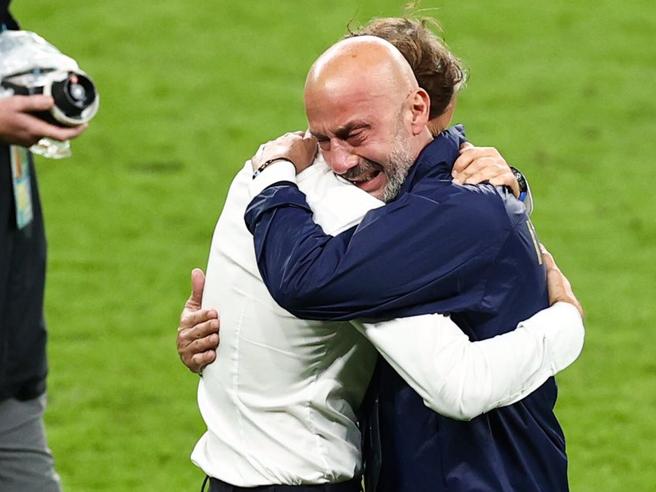
The final saw England go into the game as favourites at their home ground and they scored after two minutes to lead the final. A second-half Leonardo Bonucci equaliser eventually sent the game to penalties with the Azzurri winning the shoot-out 3-2. The win was emotional for many reasons but the fact Mancini had his friend and former Sampdoria teammate Gianluca Vialli amongst his coaching staff added to the significance of the final win. Vialli had recovered from pancreatic cancer treatment to take his place on Mancini’s coaching staff and the sight of the two embracing at the end of the game gave an emotional resonance to the post match celebrations.
The joy of the Euros could not be built upon, though, as Italy missed out on a second successive World Cup in the following campaign. A shock play-off loss to North Macedonia cost the Azzurri a place in Qatar for the finals and with it, Mancini his job. A short stint as manager of Saudi Arabia followed, but that experiment ended after little more than a year.
Mancini was recently named as Head Coach of Qatar Stars League side Al Sadd as his managerial career continues in Doha.