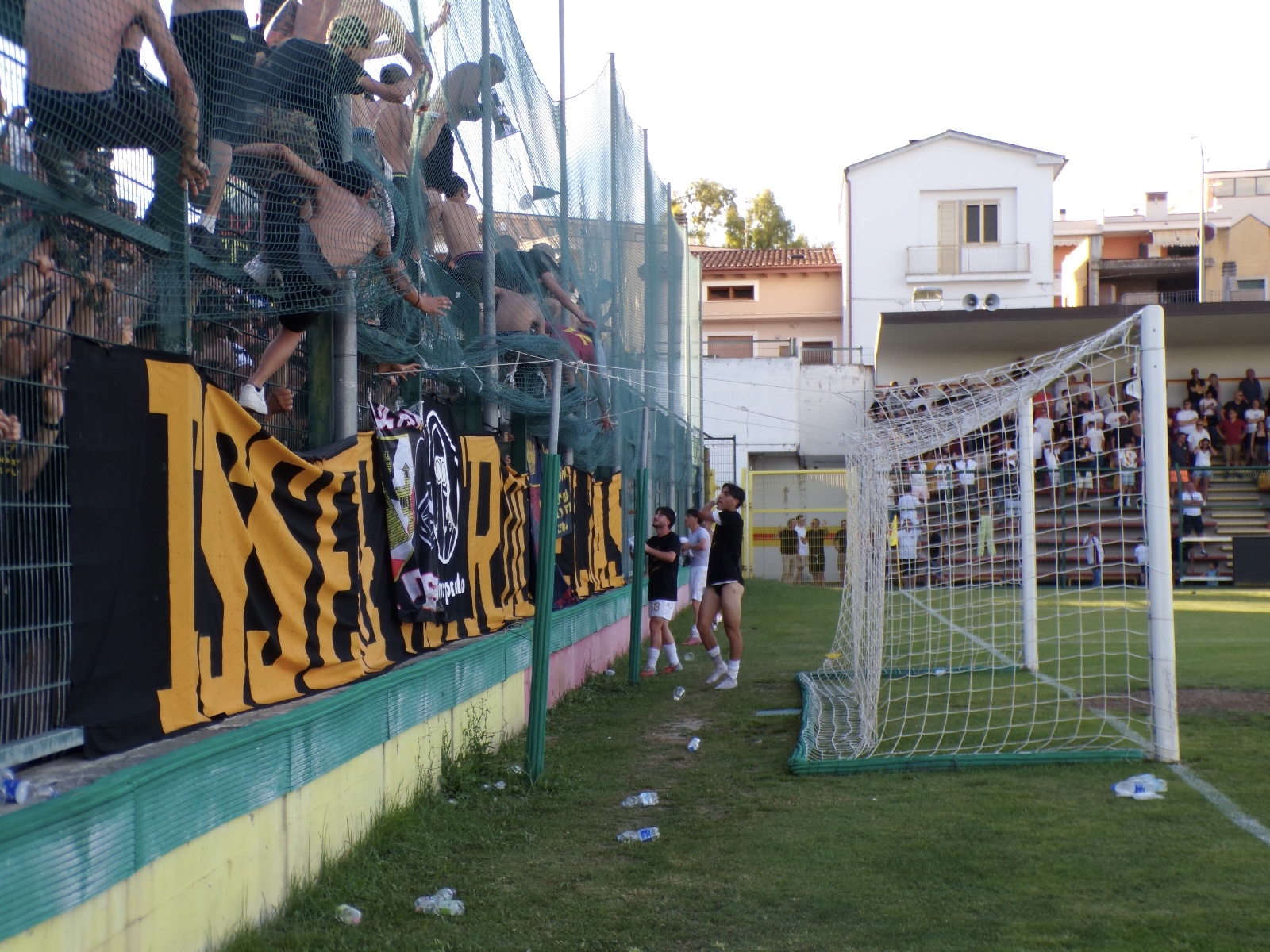
What are the Italian lower leagues really like and what makes them so interesting? For the Gentleman Ultra, Juha Joensuu takes a deep dive to discover the highs and lows of the Italian lower leagues.
If you have walked into a local bar recently and started a conversation with the bloke beside you, chances are that you had a conversation about lower league football.
In recent years, lower-league Italian football has captured the interest of fans too – perhaps even yours!
Close proximity and the desire to support your local football club are the two main reasons some are choosing to invest their time at a local ground, while others are drawn by the cheaper ticket pricing.
But, what are the lower leagues really like in Italy, and what makes them so interesting?
Photo credit: Juha Joensuu
From the Derby of Milan to the Hidden Corners of the Peninsula
For many fans of Italian football, explosive matches like— il Derby di Milano, dividing the city and beyond to either support AC Milan or Inter, satisfy even the most discerning football enthusiast. Similarly, in the ancient city of Rome, where the past and present continues to breath life, it has its very own football focal point— il Derby della Capitale, between AS Roma and Lazio, captivating the attention of locals and many others around the world, because they are truly spectacular occasions fuelled by long history, passionate fans and bitter crosstown rivalry. It’s right that they receive so much of our attention.
However, football in Italy can be much more, so I decided to take a peek behind those forgotten regional corners of the peninsula to discover what Italian lower league football was really like. And boy was I in for a treat!
What makes the lower leagues so attractive in Italy?
This question was put to me recently, since the top matches in Serie A is where you will naturally find the best of the best.
To answer the question indirectly, we could use the analogy of listening to an album of your favourite band. Then one day you discover that there’s even more music to be heard, a collection of b-sides and rare live recordings. Now, you’re not only hooked, you love the band even more, vastly increasing your listening enjoyment.
In football terms, this is what it feels like to discover the Italian lower leagues, with even more flair and colour and local identity than you thought possible. And the quality of the football? Well, the atmosphere makes up for the natural drop, and the beers only cost half the price. Just kidding, it’s actually way better than that!
Photo credit: Juha Joensuu
In Search of Authenticity in the Italian Lower Leagues
While most of continental football was wrapping up for another summer break, I went in search of authenticity in the Italian lower leagues.
On a Sunday mid-afternoon, I follow the trail of terrace noise drifting with the breeze from a nearby ground. Santegidiese, the local team, is hosting a match. Once inside, I’m drawn towards massive flags bearing the words “Passione e Mentalità” and “Tradizione Ultras” being waved back and forth through the vibrant fan section behind the glass barrier which separates the fans from the pitch. Yellow-red smoke encircles the fans, blanketing the entire terrace.
“Vinci per noi, vinci per noi, forza Sant’, ale ale ale!” (“Win for us, win for us, c’mon Sant’, ale ale ale!”) echoed from a crowd of two thousand Sant’ supporters after a late 85th-minute equaliser in the second leg of the national play-off final against visiting Tuscan club Grassina. The goal sent the match into extra time, where Santegidiese bagged two more goals to seal the victory and lift the promotion title in front of their boisterous fanbase. It was no easy feat, as promotion from the fifth-tier Eccellenza championship is contested by 475 other clubs divided into 28 regional groups across Italy. Undeterred, the club’s directors rolled up their sleeves and worked tirelessly to reach a division where the stakes truly matter.
Only a few years ago, the club faced bankruptcy and had to restart from scratch in the lower regional leagues, playing week in, week out on sandy pitches with primitive stands in front of just a handful of locals.
However, fans and local businesses in the hilltop town of Sant’Egidio alla Vibrata shared a clear vision to back the club—not only from the terraces, but by rebuilding it from the ground up, reinventing themselves as active, equity-holding decision-makers. Following four successive promotions from the ninth tier to the fourth, the Abruzzese club is now playing in Serie D, only three promotions away from facing the elites of Italian footbal. So, is the best yet to come? So far so good for Santegidiese, but with each new phase comes a fresh challenge. One thing is for sure, though: every Sunday with Santegidiese is bound to be unforgettable, both on and off the pitch.
Photo credit: Juha Joensuu
Making Connections Italian Lower Leagues
A fellow pitchside photographer along the Adriatic coast named Eugenio, who also has his own social channel: Ultras Ricordi, summed up the lower league football in his own words: “I would much rather attend regional Serie C matches featuring passionate, well-organized fanbases—even if smaller in number—than go to a top-flight match at Roma or Milan where a massive crowd is reduced to just a handful of cramped spaces”. He makes a good point.
In fact, at lower league football matches you can get more of those genuine connections with the locals than in a crowd of thirty to sixty thousand.
For the most part, Italians like to talk! All it takes to spark a conversation is a few words, and you usually walk away feeling enriched and connected—you might even find yourself uttering a few colourful, spontaneous expressions of your own!
Photo credit: SuperTifo
Il Derby d’Abruzzo
Il Derby d’Abruzzo, the derby between Teramo and Giulianova, is one of central Italy’s fiercest and most contested rivalries. When fixtures are released, locals circle these dates immediately; the mood of an entire season hinges on these two matches.
At Teramo’s Bonolis stadium, the local fans have packed the stadium nearly to capacity. The section behind the goal is filled with large white-and-red flags featuring designs of the club mascot, il diavolo, while fans sing at the top of their voices: “Forza Diavolo, Forza Diavolo!!!”.
On the other side of the pitch, the Giulianova supporters display their own distinct style of support—along with plenty of banter along the way. The entire away section joins in the chorus, “Chi non salta è un teramano, ooh ooh!”, creating a healthy friction with the home crowd.
I soon found myself drawn into a conversation with two older gentlemen. They tipped their hometown club, Teramo, for direct promotion to Serie C, adding that a derby win would be the cherry on top of the season. Their optimism is well-founded: after missing out by the narrowest of margins last year, Teramo have reinforced their squad and are going neck and neck with another ambitious club from Abruzzo, L’Aquila.
Additionally, Teramo have the infrastructure—including the stadium and a large enough fan base to draw from—to make a progressive move into the professional leagues a real possibility.
Their ground, the Stadio Gaetano Bonolis, is a purpose-built football stadium with a current capacity of 12,000, making it one of only a handful of new stadiums built in Italy over the last two decades. Just a short journey from the town centre, it was designed with a large parking area to handle big turnouts, and its location next to a modern shopping mall makes the matchday experience one of the most comfortable in the country. While it is no secret that Italian stadium infrastructure has lagged behind for decades, clubs like Teramo—alongside their local council—truly value football in the city and are looking positively toward the future.
What about the match? How did it finish? Teramo came out the winners with a 3–2 result at the full-time whistle, giving the local club all the reason to continue on the path it has set for itself, now with one cherry on top.
So, what makes Italian lower-league football so compelling?
Spend enough time visiting grounds from the top divisions down to the regional tiers, and you quickly see what makes the game here so special. With a pinch of ancient history as a backdrop and a dash of Latin culture for flavour, you can easily be forgiven for losing yourself in it all—especially if you decide to peek around a quiet regional corner of the Italian peninsula yourself.