
“Napoli è della gente”: A century of football, a city’s declaration of belonging. Alessandro Cangiano’s photographs of Napoli’s centenary celebrations capture the devotion, friendships and defiance of a support united by a clear message: Napoli belongs to the people.
A bare chest becomes a declaration. Across backs, shoulders and arms, supporters carry the names and symbols of their allegiance: Napoli, Curva ‘A’, Mastiffs. Maradona appears on skin and fabric, his image moving through the streets above the heads of people for whom his place in the city’s life has never diminished.
Among these enduring symbols is a newer inscription: a Scott McTominay “McFratm” tattoo. Another player absorbed into the language and affections of Naples, another expression of how quickly football can become personal here.
Photographed in black and white by Alessandro Cangiano, these details form part of a much larger portrait of Napoli’s centenary celebrations. There is spectacle throughout, but the photographs draw their strength from proximity. Cangiano moves alongside supporters, close enough to register expressions, exchanges and the friendships holding the occasion together.
Born and bred in Naples, he photographs a culture he knows from within.
“Football is something that has always been in the air – in the family, in the streets, everywhere.”

A procession through Naples
The main procession is heavily populated by Neapolitan men, their tops removed or their bodies wrapped in shirts from different eras. The tattoos speak of commitments carried every day, long after the flags and banners have been folded away.
Maradona flags share the streets with banners featuring Popeye the Sailor Man. Supporters appear in traditional dress; donkey props add another layer of humour and theatre. The celebration has its own visual vocabulary, assembled from football, local identity and heritage.
One supporter, dressed as the Pope, poses with two women. Elsewhere, older faces emerge from the crowds, watching, smiling and joining in. Children stand among adults, taking their place in a gathering where different generations seem entirely at ease together.
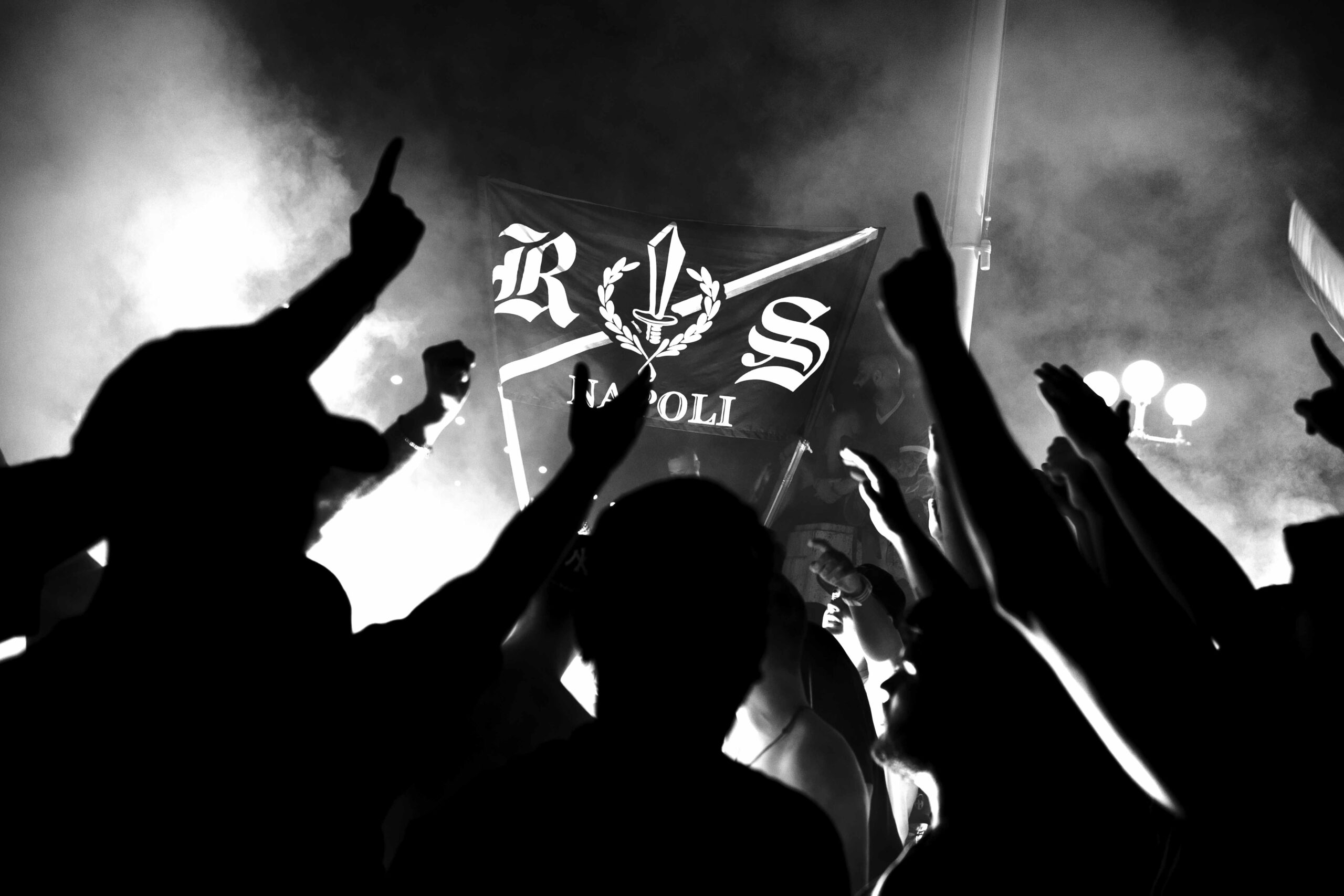
There is something almost biblical about Cangiano’s photographs. Raised arms, tightly gathered bodies and banners held overhead give the streets the intensity of a religious procession. His gritty monochrome deepens that impression, bringing attention to faces, gestures and the physical closeness of the crowd.
Away from solemnity of the procession there are photographs full of smiles. People smoke, drink, embrace and pose for one another. Beneath the scale of the occasion is the simple pleasure of being together – being brought together for the love of their club – their city.
“I’m a street photographer and I like to document everything that happens, and the people involved,” Cangiano explains. “This was a unique event and opportunity: a celebration of the club’s 100th anniversary. Everyone came out into the streets for it – ultras groups and supporters, together.”

The people behind the spectacle
Cangiano’s relationship with Napoli began watching matches at his grandfather’s house. His childhood memories include players such as André Cruz, Roberto Ayala and Alfredo Aglietti. His support also encompasses relegation, the club’s bankruptcy in 2004 and its restart in Serie C as Napoli Soccer.
That history gives substance to his understanding of belonging. He has known a Napoli far removed from the confidence and visibility associated with recent success.
“Napoli represents the sporting culture of Naples,” he says. “Napoli is Naples.”
The centenary brought together figures from different chapters of that story. Rapper Clementino attended, as did Salvatore Carmando, the masseur so closely associated with Maradona’s years at the club, and former president Corrado Ferlaino, who brought the Argentine to Naples. Roberto Sosa represented another significant period: arriving after bankruptcy and remaining through the rise from Serie C to Serie A.
Their presence connected the celebration to memories held across generations. But Cangiano’s attention repeatedly returns to the supporters themselves.
“Every photograph can tell us something. There are different moments, but some reveal the relationships between the ultras themselves – a human connection built on strong friendships.”
Those relationships are visible throughout the series. The affection is directed towards the club and towards one another. Familiarity shows in how people stand together, in an embrace, or in the confidence with which someone turns towards the camera.
As evening arrives, the atmosphere changes. Flares burn beneath flags silhouetted against the night sky. Some supporters take the celebrations down to the beach, extending the gathering to the shoreline. The light falls, but the sense of togetherness remains.

“No Business”
Running through the photographs is a message that complicates any reading of the occasion as straightforward anniversary pageantry.
“No Business” appears on banners. So does the declaration that gives this collection its subtitle: “Napoli è della gente.”
Napoli belongs to the people.
“The ‘No Business’ slogan reflects opposition to the commercialisation of football; true fandom stems from passion and a sense of belonging to one’s team, not from financial dealings,” says Cangiano. “The ultras entirely self-funded this celebration.”
That detail is central to understanding the event. The supporters organised and paid for their own expression of the club’s identity. The resulting spectacle demonstrated their ability to create something culturally powerful through collective commitment.
“Above all, the event was defined by a single slogan: ‘Napoli belongs to the people,’” Cangiano continues. “This was the most important element – a simple, clear, and direct message affirming that the Napoli team belongs to its fans, and to no one else.”
Read alongside the photographs, those words acquire a human scale. “The people” are the older supporters, the children, the friends standing shoulder to shoulder and the men carrying their allegiance permanently across their skin.

Beyond the romantic view
For many British supporters, an attachment to Italian football took hold in the early 1990s. The shirts, stadiums, players and atmosphere offered an irresistible combination. That fascination has endured, often accompanied by a romantic belief that Italy retains something other football cultures have allowed to slip away.
Lower Block’s wider photographic work explores that attraction through publications including Napoli – Campioni d’Italia, Ultras Italia 2024-25, Forza San Siro and Leoni di Venezia. Together, these collections reveal distinct places and communities within a culture too rich to reduce to a single image of Italian football.
Cangiano’s photographs reward that fascination while asking us to look more closely. Napoli’s supporters are confronting questions familiar across Europe: how clubs develop commercially, whose interests shape that development, and whether local supporters can remain central to the institutions they sustain.
Progress brings opportunities. It also demands decisions about access, identity and the value placed on a club’s heritage. The supporters’ message insists that these decisions must account for the people whose lives give that heritage meaning.
In Cangiano’s photographs, a century of Napoli is celebrated through bodies, memories, friendships and shared streets. The declaration running through them is clear. Whatever comes next, the people expect to remain at its heart.
Napoli 100 – Napoli è della gente by Alessandro Cangiano is published by Lower Block and available at lowerblock.com.
