
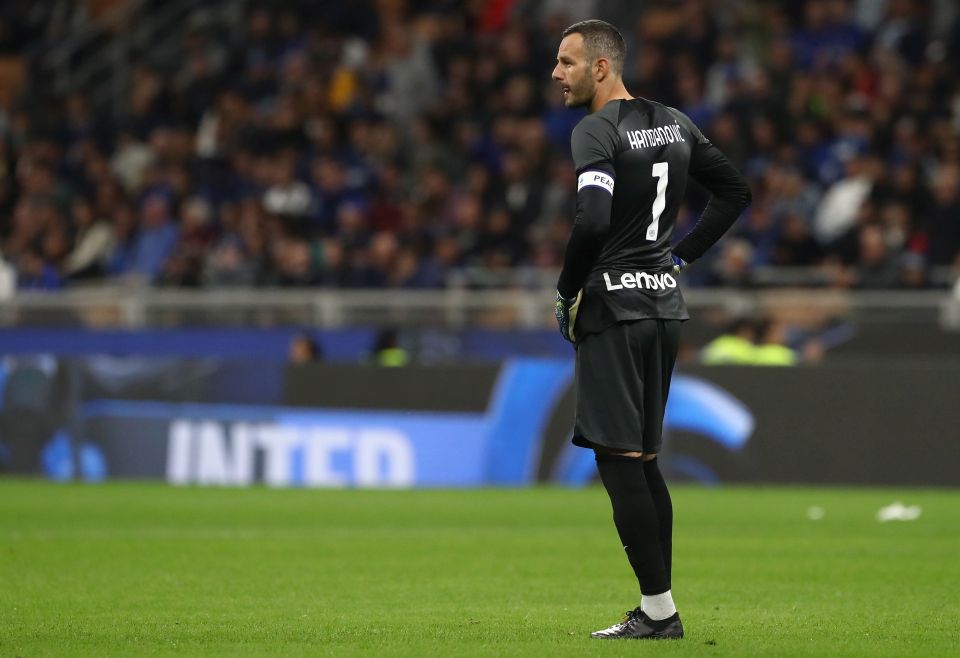
The story of Samir Handanović is not one of explosion, but of compression. It is a narrative meticulously folded into itself, defined by discipline, longevity, and the rare gift of absolute stillness amidst chaos. In the pantheon of modern Serie A goalkeepers, where the flamboyant acrobat and the foot-playing libero often steal the spotlight, Handanović, the Slovenian sentinel, stands apart. He is the master of the low-key miracle, the architect of the calculated save, and the physical embodiment of stoicism—a towering, silent presence whose career was a testament to enduring quality over fleeting spectacle.
For over two decades, from his arrival at Treviso as a young, raw talent to his final, legendary seasons captaining Inter, Handanović defined the very concept of affidabilità (reliability). His career was a study in profound consistency, a quiet metronome ticking over in the heart of some of Italian football’s most turbulent periods. Where other greats became symbols of specific eras or tactical revolutions—Buffon embodying the traditional numero uno, or Donnarumma representing the new, gilded generation—Handanović became the rock. He was the unmoving certainty in a league often addicted to melodrama.
Born in Ljubljana in 1984, Handanović’s professional journey in Italy began with a necessary apprenticeship. After short, formative spells at Udinese, he embarked on the classic Italian lower-league giro—loans to Treviso, Lazio (where he warmed the bench), and Rimini. These years were crucial, stripping away any nascent arrogance and forging the mental resilience that would define his later career. It was in the unforgiving trenches of Serie B that Handanović honed his physical gifts—the immense wingspan, the cat-like reflexes, and the near-superhuman ability to block close-range shots with his legs.
He returned to Udinese in 2007, and it was here, in the Friuli region, that the legend truly began to take shape. For five seasons, Handanović became the silent lynchpin of a side that consistently punched above its weight, battling for European places. It was here, too, that he developed the skill that would become his calling card, his unique signature in the history books: The Penalty Killer.
Handanović’s record against penalties is simply astonishing, bordering on the statistical ridiculous. During his career, he saved an incredible 32 penalties in Serie A—more than any other goalkeeper in the competition’s history, surpassing even the long-standing record held by Gianluca Pagliuca. This was no accident; it was a blend of deep study, psychological warfare, and a defining characteristic: pazienza (patience). Unlike keepers who dive early, he developed a technique of waiting until the absolute last possible millisecond, using his imposing 6’4” frame to intimidate, and then launching into a full-stretch, often two-handed, block. He possessed an almost eerie ability to read the minute shifts in the striker’s balance and eye movement, making the penalty spot his own personal theatre of domination. The success rate was a product of his ability to delay commitment, turning a binary choice into an optical illusion for the shooter.
In the summer of 2012, after nearly a decade of consistency, the inevitable happened: Inter, desperate to find a worthy heir to the legendary Júlio César, came calling. The move to San Siro was not merely a transfer; it was a step into a crucible. Handanović arrived during one of the most chaotic and transitional periods in Inter’s history, immediately following the treble-winning era and preceding the stability brought by Antonio Conte.
For years, Handanović was the sole constant in a rapidly rotating cast of coaches, presidents, and players. While the defence in front of him often wavered, he remained a fortress. His performance levels never dipped. He was the keeper who regularly finished seasons with the most saves in the league, often due to the sheer volume of shots his exposed defence allowed.

His playing style as a shot-stopper was pure classicism tempered by modern athleticism. He was not a high-flying, spectacular ‘showreel’ keeper like the South American school often produces. Instead, his technique was defined by economy of movement and positional mastery. He favoured setting his feet quickly and covering angles geometrically, often making difficult saves look routine simply because he was already in the right place. His lateral push off for a full-stretch dive was exceptionally powerful, allowing him to reach corners that looked impossible, but his movements were rarely excessive.
A key element of his shot-stopping was his mastery of the ‘set position’—the moment he prepared to meet the ball. Handanović would adopt a wide, slightly crouched stance, creating a colossal wall with his body. This technique, combined with his phenomenal wingspan, meant that shots aimed close to his body often resulted in blocks or deflections rather than catches. His handling was solid, but his real genius lay in his ability to use his limbs like paddles, turning powerful close-range strikes over the bar or around the post. He used his legs especially well in one-on-one situations, often dropping quickly to smother the low-driven ball, a hallmark of his training methods. The sheer magnitude of his saves during the tumultuous post-Mourinho years cemented his image as the anti-drama pillar; the quiet strength that allowed others to panic. His nickname, ‘Batman’, was earned not just for the dark kit he often wore, but for his capacity to appear suddenly and save the day, seemingly without effort or fuss.
As modern football evolved, demanding that the goalkeeper be the eleventh outfielder, Handanović faced the challenge of adapting his game. He was, tactically, the last of the great line-keepers. Unlike his contemporary Manuel Neuer, who pioneered the hyper-aggressive sweeper-keeper role, Handanović’s default positioning remained closer to the goal line, favouring security over extreme risk. He covered the space behind his defence reliably but without the alarmingly high starting position of a libero. He was excellent at commanding his six-yard box, but his presence rarely extended beyond the penalty arc in open play.
His distribution was reliable, but rarely revolutionary. In the build-up phase, his passes were accurate and safe, usually aimed to an open centre-back or full-back to restart the flow. He was measured rather than expansive, never seeking the risky long diagonal ball that could instantly break defensive lines, preferring instead to give his outfield players the responsibility for verticality. This choice reflected his overall philosophy: the goalkeeper’s primary job is to save the ball, not create attacks.
The Conte era, however, saw a clever modification of his role. Antonio Conte’s disciplined, three-man defence (the 3-5-2formation) provided the structural support that Handanović had lacked for so long. The system was designed to minimise space for the opposition, reducing the number of high-exposure, one-on-one situations the keeper faced. Now, his primary strength—shot-stopping and commanding the area—was maximised, and the demands on his footwork were streamlined and manageable, focusing on short, accurate passes to the central defenders.
The 2020-2021 season saw Inter break Juventus’s decade-long domination and win the Scudetto. As captain, Handanović finally lifted the trophy his years of silent toil had earned. This title was not a sudden triumph, but the vindication of quiet endurance. It was a testament to the man who arrived during the ruins of one great era and stayed, save after save, until he had built the foundation for the next. The image of the usually expressionless Handanović allowing a rare, understated smile as he received the tricolore medal is perhaps the perfect visual summary of his career—a moment of well-deserved, controlled joy.
Handanović’s depth extends beyond the goalposts. Off the field, he is famously guarded and philosophical, traits that mirror his on-field persona. His interviews are sparse and focused, lacking the soundbites or emotional declarations common in the sport.
“I don’t think about saves,” he once stated, “I think about the next ball.” This mindset reflects a profound commitment to the present moment, a rejection of both past mistakes and future hype. It’s the mental discipline that allowed him to shrug off errors and maintain his focus across a 90-minute war of attrition. His dedication to fitness was legendary, known for being one of the first to arrive and the last to leave training. His physical condition, which allowed him to perform at an elite level well into his late 30s, was a product of relentless, almost obsessive, self-management.
Unlike the charismatic, demanding leadership style of his predecessors, Handanović led by example. He was the ultimate professional, the standard-bearer whose quiet intensity forced his teammates to rise to his level. This quiet authority, this Orso (Bear) like quality of silent strength, is what made him such an effective, if unconventional, captain for Inter.
Samir Handanović concluded his playing career in 2023, leaving behind an indelible mark on Inter and Serie A. His final years were spent mentoring the next generation, preparing the way for his successor André Onana.
His legacy is not defined by any one spectacular moment, but by the accumulated weight of thousands of competent, crucial, and often unfashionable saves. He was the quiet giant who perfected the art of occupying space, mastering the dive, and dominating the penalty spot. He was the stoic sentinel who proved that sometimes, the greatest revolutions in football are not noisy or chaotic, but are achieved through the simple, unrelenting power of professionalism and quiet, enduring quality. Handanović was the rock, the anchor, and the ultimate testament to the power of stillness in a perpetually moving game.
Words Richard Hall
@RichHall80