
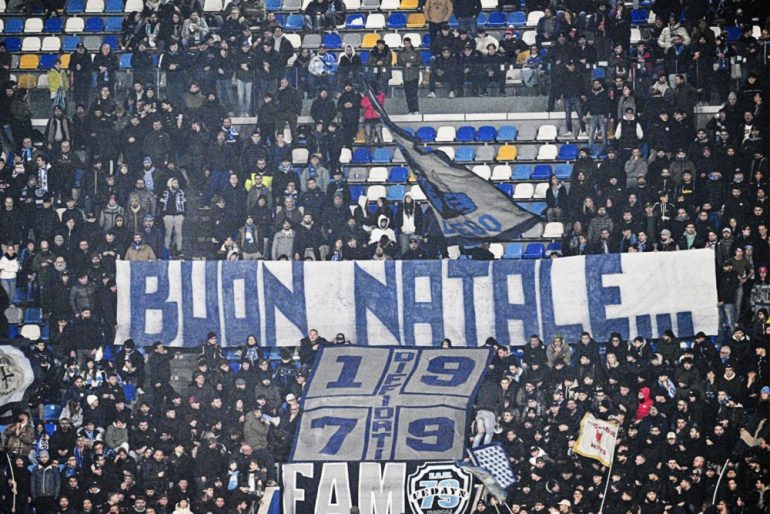
After a Christmas Day spent indoors — behaving politely with family, drifting in and out of conversation, half-watching the same James Bond films that seem to exist solely for this time of year — I always feel the same quiet relief. Boxing Day arrives. The pubs open. The racing begins. And most importantly, the football returns.
In England, this rhythm feels instinctive. Christmas Day belongs to the family. Boxing Day belongs to the outside world. Since the late 1960s, when league football quietly shifted from Christmas Day to the 26th, the festive calendar has barely been questioned. Boxing Day football isn’t an event here — it’s a habit. Italy, though, has never shared that instinct.
There has never been a reliable festive fixture list in Italian football, no December tradition passed down through generations. Matches have appeared occasionally — sometimes through necessity, sometimes through experimentation — but they have never settled. And after one particularly ill-fated attempt in 2018, Santo Stefano, as the 26th is known in Italy, has come to feel almost untouchable. Cursed, even.
Different Cultures, Different Attitudes
The difference begins with how the day itself is understood. In England, Boxing Day has long functioned as an escape valve. A day for movement, noise, and release after the enforced stillness of Christmas. In Italy, the 26th does not interrupt Christmas — it extends it. Santo Stefano is not a reset but a continuation. The celebrations simply soften. The pace slows further.
As a friend once explained to me, the calendar itself shifts as you move through the country. In parts of the south, Christmas Eve carries the emotional weight; in the north, Christmas Day remains the focal point. But the common ground arrives on the 26th. That is the day you rest. You recover. You eat lightly. Brodino replaces excess. The table remains the centre of gravity.
Italy remains, in many ways, more observant than England now, and Santo Stefano retains a quiet dignity. It is treated with respect. It is a day for family, for calm, for peace. Not for floodlights and kick-off times. Not for the noise of competition. This reflects something broader: Italian culture tends to turn inward during its holidays, while English culture, especially around football, tends to spill outward — into pubs, onto trains, through turnstiles. And yet, in 2018, Italian football tried to lean the other way.
Un-festive Football
On 26 December 2018, Serie A staged a full round of fixtures. It was officially marketed — especially abroad — as “Boxing Day Serie A”. The Italian name for the day, Santo Stefano, was quietly sidelined. This was a deliberate act of branding, an attempt to borrow not just England’s scheduling, but its symbolism.
From the start, the resistance was audible. Players and coaches criticised the idea, but not in the familiar English terms of fatigue or fixture congestion. This was something else. The objections were cultural. Family life disrupted. Rhythm broken. Something simply felt wrong.
Fans were split. Curiosity wrestled with tradition. Novelty pressed against habit. Italian football stood briefly at a crossroads.
In Milan, it all unravelled.
Inter vs Napoli was meant to be the centrepiece of the experiment: two major clubs, national television, a festive audience. Instead, it became one of the darkest days in modern Italian football. Throughout the match, Napoli defender Kalidou Koulibaly was subjected to sustained racist abuse from sections of the Curva Nord — monkey chants, whistling, coordinated insults. Koulibaly, visibly distressed, was eventually sent off after a gesture of bitter irony toward the referee.
Racism, tragically, was not new to Serie A. But this was Santo Stefano. A day promoted as inclusive. A day framed as family-friendly. The dissonance between the marketing and the reality was impossible to ignore.
Worse still, the violence had already begun before a ball was kicked. In clashes between Inter and Napoli ultras near San Siro, an Inter supporter was killed after being struck by a vehicle. Arrests followed. Sentences were handed down. But the damage was already irreversible.
Within hours, the Boxing Day experiment ceased to be about modernisation or learning from England. It became about racism, ultra violence, and loss of control. A day meant to soften Italian football instead exposed its hardest edges.
Will Santo Stefano Football Come Back?
This is why Santo Stefano 2018 still lingers uncomfortably in the Italian football memory. Not because Italy cannot host festive football, but because traditions cannot be imported wholesale. England’s Boxing Day works because it is routine, inherited, normalised. It has been absorbed over decades. In Italy, Santo Stefano was suddenly burdened with expectation — morally framed as “family football” without the cultural scaffolding to support it.
When things went wrong, it did not feel like a football scandal. It felt, to many, like a violation of Christmas itself.
Since then, Serie A has retreated once more into its familiar winter pause, restarting around Epiphany, as it long has. Football will continue to creep closer to the festive period — expanded tournaments, global calendars, and commercial pressures make that inevitable. But a full-blooded festive programme, English-style, remains unlikely.
Some traditions evolve. Others endure by knowing when to step aside.
In England, football pours into Christmas.
In Italy, Christmas still asks football to wait. And perhaps that, more than any fixture list, explains the difference.