
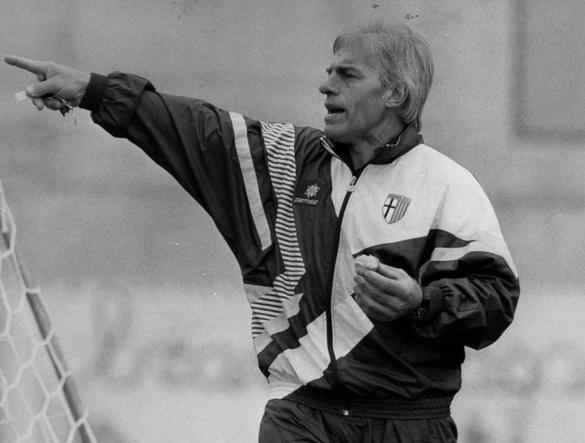
The subject for the latest in our series on Italian managers is the man that was in charge of one of my favourite Serie A sides of the 1990s.

Nevio Scala
Nevio Scala’s playing career saw him represent some of Italy’s biggest clubs. He was part of the AC Milan squad that won Serie A and the Cup Winners Cup in 1968 before going to lift the European Cup the following season. The midfielder also represented Inter, Roma and Fiorentina amongst others before ending his career down the leagues with Adriese.
Scala’s managerial career began in earnest in 1987 when he took charge of Serie C1 side Reggina, having previously been in charge of the youth side at Vicenza. He led his side to promotion to Serie B in his first season in the hot-seat after a third-place league finish saw them into a play-off in which they were victorious over Virescit Boccaleone from Bergamo.
Reggina
Scala led Reggina for a season in Serie B before Parma, who were also playing in the second tier at the time, lured him away to fill their managerial vacany. It was the start of seven seasons for him at Parma in which the club went from lower league mainstays to European heavyweights.
In his first season at Stadio Ennio Tardini, Scala led Parma to an historic promotion to Serie A, the first time they had been in the top-flight of the Italian game. During their triumphant Serie B campaign, club president Ernesto Ceresini died which eventually led to local businessman and founder of dairy food processing giant Paramalat, Calisto Tanzi, taking over the club. Calisto had taken his small pasteurisation plant in Parma and turned it into a billion-Euro multinational organisation. It was hoped that with his investment, the football team could follow a similar path from a small regional club into challengers on the national and European stage.
Brolin and Asprilla
In his first season in Serie A, Scala brought Brazilian goalkeeper Claudio Taffarel and Swedish striker Tomas Brolin to the club as he led his side to a sixth-place finish. That top six placing qualified Parma for the UEFA Cup as they consolidated their place in the top tier of the Italian game. Season two in Serie A, Scala’s third in charge of the club, saw the side finish in seventh position in the table. They also exited Europe at the first hurdle, losing to Bulgarian side CSKA Sofia. The season was far from a disappointment though as a 2-1 aggregate win over Juventus saw Parma win their first major piece of silverware in the final of the Coppa Italia.

Scala added a player who would become synonymous with Parma in the 1990s ahead of the following campaign as the cup winners looked to strengthen their search for further trophies. Mercurial Colombian striker Faustino Asprilla joined the club and he would go on to play 150 times for the club scoring 42 goals along the way. The 1992/93 season saw Parma secure their best-ever league finish as they ended the campaign in third position. It was again cup competition that brought the highlight of their season as they lifted their first ever European trophy. Asprilla was on the substitutes bench as goals from Lorenzo Minotti, Alessandro Melli and Stefano Cuoghi gave Scala’s side a 3-1 win over Royal Antwerp to win the Cup Winners Cup.
Super Cup
Gianfranco Zola and Roberto Nestor Sensini were brought in at the end of the campaign as Scala attempted to push towards the Serie A summit. The 1993/94 season saw them place in fifth, the fact that this was a disappointment showed how far the club had moved on. They lifted the UEFA Super Cup by beating European Champions Milan and were foiled by Arsenal in the final of the Cup Winners Cup as they came within a game of successfully defending that trophy.
The 1994/95 season saw further success for Scala’s Parma who had gathered something of a cult following and were seen as many people’s second favourite team. The incomings were impressive as the club flexed their financial strength by bringing in the likes of Dino Baggio, Fernando Couto, Roberto Mussi, and Stefano Fiore. The signings paid off as Parma ended the campaign in third place in Serie A but added more silverware to their trophy cabinet. A 2-1 aggregate win over Juventus saw Parma lift the UEFA Cup, although Juve got their revenge by winning the Coppa Italia against Scala’s men a few weeks later.

Buffon and Cannavaro
The 1995/96 season would prove to be Scala last in charge of Parma as his legendary tenure came to end at the culmination of the campaign. There was no silverware to celebrate come the end of the season and the final Serie A table saw Parma finish in sixth. There were bright points as Bulgarian legend Hristo Stoichkov joined the club along with young centre-back Fabio Cannavaro. Scala’s final season at the Ennio Tardini also saw him give a debut to 17-year-old goalkeeper Gianluigi Buffon.
Scala left Parma in the summer of 1996 and briefly returned to the dugout the following season in a failed attempt to try and save Perugia from relegation. The Italian moved to Germany to take charge of Borussia Dortmund and later had spells at Besiktas, Shakhtar Donetsk and Spartak Moscow.

Golden Period
It is somewhat surprising looking back that Scala never returned to Italian football given his successful spell at Parma. It was later revealed that Real Madrid tried to prize him away from Parma at the height of his success there, an opportunity which he turned down. He could also have been manager of Scotland at one point having applied and been considered for the national team role before Berti Vogts and later George Burley were given the job. Scala’s time in charge of Parma was the most successful period in the club’s history and his style of play brought admiration from across the footballing world. A golden period for the club and their inspirational manager of the time.
Words by Mark Gordon