
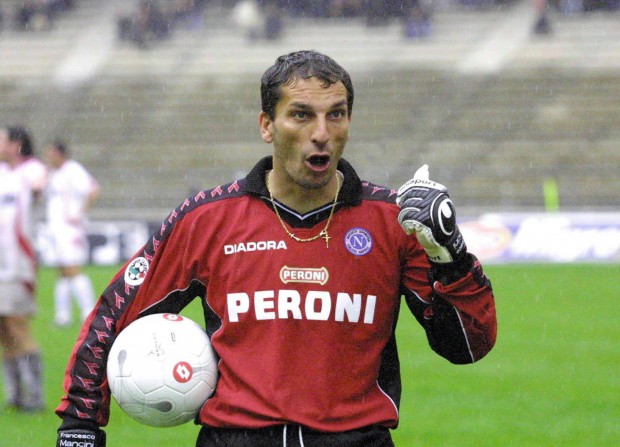
The story of Francesco Mancini is less the chronicle of a football player and more the narrative of a football revolution, confined to the 18-yard box. He was the anchor of the great Zemanlandia, the maverick goalkeeper who not only saved shots but started attacks, redefining his position in the hyper-attacking, chaotic, and unforgettable Foggia side of the early 1990s. Born in Matera in 1968, Mancini’s early career was unremarkable, a quiet progression through the lower leagues of Italian football. It was a career trajectory marked for anonymity until the summer of 1989 when the eccentric, chain-smoking Czech tactician Zdeněk Zeman returned to Foggia, and destiny placed a quiet, thoughtful man between the sticks of a side set to shock Italian calcio.
Zeman’s arrival heralded the inception of Zemanlandia—a mythical territory of football defined by his relentless 4-3-3 formation, a high defensive line pressed almost to midfield, and an unyielding commitment to attack at all costs. This system’s success hinged on one crucial, counter-intuitive component: the goalkeeper. Zeman famously required his keepers to be “the 11th outfielder,” a player as comfortable with his feet as with his hands, capable of covering the colossal, exposed space behind the high defensive line. Francesco Mancini possessed the precise blend of athleticism, composure, and technical confidence to execute this impossible task.
Mancini’s role was fundamentally different from that of a traditional Italian goalkeeper, a role historically defined by the parsimonious preservation of the clean sheet through deep positioning and gravitational pulls to the goal-line. Mancini, however, was a “goalkeeper-libero,” a sweeper who operated outside his penalty area with alarming regularity. He was constantly scanning the field, poised to charge out, often 25 or 30 yards from his goal, to intercept long through balls, clear danger, and initiate the rapid-fire counter-attacks that characterized Foggia’s play. The sheer audacity of his positioning was terrifying; every single touch outside the box was a tightrope walk over the chasm of an open-net goal. Yet, Zeman’s confidence in him was absolute, believing that the risks were outweighed by the strategic advantages of turning defence into instant offence. Mancini’s composure, therefore, was not merely a desirable trait, it was the essential, high-octane fuel for the entire system.
This dynamic was spectacularly successful, propelling Foggia from Serie C1 to Serie A in three glorious seasons. The rise was dubbed a miracolo, a true underdog story played out with a style that delighted purists and horrified pragmatists. The Foggia squad—featuring emerging stars like Giuseppe Signori, Francesco Baiano, and Roberto Rambaudi—was built for speed and verticality, but Mancini provided the vital link, the metronome at the back. His distribution was not simply a punt downfield; it was a precise pass to a midfielder or a quick, low throw to a full-back, restarting the flow immediately, often catching opponents still recovering from their failed attack.
The years between 1991 and 1995, when Foggia shone in Serie A, were Mancini’s zenith. His unorthodox style led to a string of highly visible, high-risk manoeuvres that defined his legend. The most famous, often recounted with the hushed reverence of a heroic myth, involved the iconic AC Milan striker Marco Van Basten. In a match against the Rossoneri, Van Basten, the reigning Ballon d’Or winner, was chasing a ball over the top, guaranteed to score against a high-pressed defence. Mancini raced out, but instead of the expected, frantic slide or boot upfield, he waited, allowed Van Basten to commit, and then, with breathtaking coolness, executed a sombrero—a deft flick of the ball over the Dutchman’s head—before gathering it on the other side and setting up a counter-attack. It was an act of pure, technical arrogance that perfectly encapsulated the Zeman philosophy: use skill and nerve to conquer fear and convention. This single moment, performed against a legend, cemented Mancini’s image as “L’Higuita Italiano” and the fearless “goalkeeper-libero” who could play mind games with the world’s best.
Mancini’s complexity extended far beyond the pitch. While his on-field persona was that of a cool, calculating risk-taker, off the field, he was known as a mild, quiet, and deeply philosophical man—a contrast Zeman affectionately acknowledged by giving him the nickname “L’Orso,” The Bear, for his taciturn nature. His true passion lay not in the roar of the crowd but in the steady rhythm of music, specifically Reggae, and the explosive joy of drumming. Mancini was an accomplished drummer, often bringing his kit to Foggia’s training camps and playing with local bands. This dedication to rhythm and timing, a precision honed through countless hours behind the drum kit, undoubtedly informed his goalkeeping; the ability to anticipate the beat of the attack, to wait for the crucial moment before charging or diving, mirrored the steady, syncopated flow of a Reggae rhythm. It was a passion that offered respite and focus, balancing the high-pressure environment of Zemanlandia.
Equally influential was his quiet religious faith. In a team led by Zeman, a coach openly dismissive of superstition and often depicted as an anti-establishment figure, Mancini was a devout Catholic. He became the quiet, spiritual leader of the Foggia squad, instrumental in organizing team pilgrimages to the nearby shrine of Padre Pio in San Giovanni Rotondo. This confluence of bohemian music, spiritual depth, and revolutionary football philosophy made Francesco Mancini one of Italian football’s most magnetic, multi-faceted figures.
After Zeman’s departure from Foggia, Mancini continued his solid career in Serie A, playing for Bari (where he was a stalwart for three seasons) and Napoli. He proved his consistency and reliability even outside Zeman’s high-wire act, showcasing excellent reflexes and strong command of his area. Over the course of his career, he amassed an impressive 240 Serie A appearances, a testament to his enduring quality and professionalism. His later career included stints at Pisa, Sambenedettese, Teramo, Salernitana, and Martina Franca, before he finally hung up his gloves in 2008.
However, the bond with Zeman was unbreakable. In 2009, Mancini returned to the game as a goalkeeping coach, first at Manfredonia, and then, inevitably, rejoining his mentor. He served as Zeman’s goalkeeping coach at Foggia (2010–2011) and then at Pescara (2011–2012). This final chapter of his career offered a beautiful, full-circle moment: Mancini was part of the staff that guided Pescara—a team featuring future stars like Marco Verratti, Ciro Immobile, and Lorenzo Insigne—to a dramatic Serie B title and promotion back to the top flight, achieving another great Zemanlandia triumph. Mancini was now teaching the next generation of players how to thrive within the audacious system he had once embodied.

Tragically, just as Pescara secured their promotion and Zemanlandia enjoyed a modern renaissance, Francesco Mancini’s life was cut short. On March 30, 2012, while still working with Pescara, he suffered a fatal heart attack at the age of 43. The news stunned the entire Italian football community. Zeman, known for his stoic reserve, was reportedly devastated, publicly mourning the loss of a man he considered “a son.”
Francesco Mancini’s legacy is preserved in the annals of football history as the essential, if unsung, pioneer of the modern, ball-playing goalkeeper. He was the man with the quiet heart, the rhythmic soul, and the revolutionary positioning who demonstrated that the goalkeeper, far from being a purely reactive defensive figure, could be the key tactical lynchpin and the first architect of a thrillingly successful attacking unit. In Foggia, the Curva Nord of the Stadio Pino Zaccheria was officially named in his honour, a permanent tribute to the “goalkeeper-libero” whose cold-blooded courage and technical grace will forever define the myth of Zemanlandia.
Words Richard Hall
@RichHall80 (on X and @BlueSky)
This was an excellent read Richard. Many thanks