
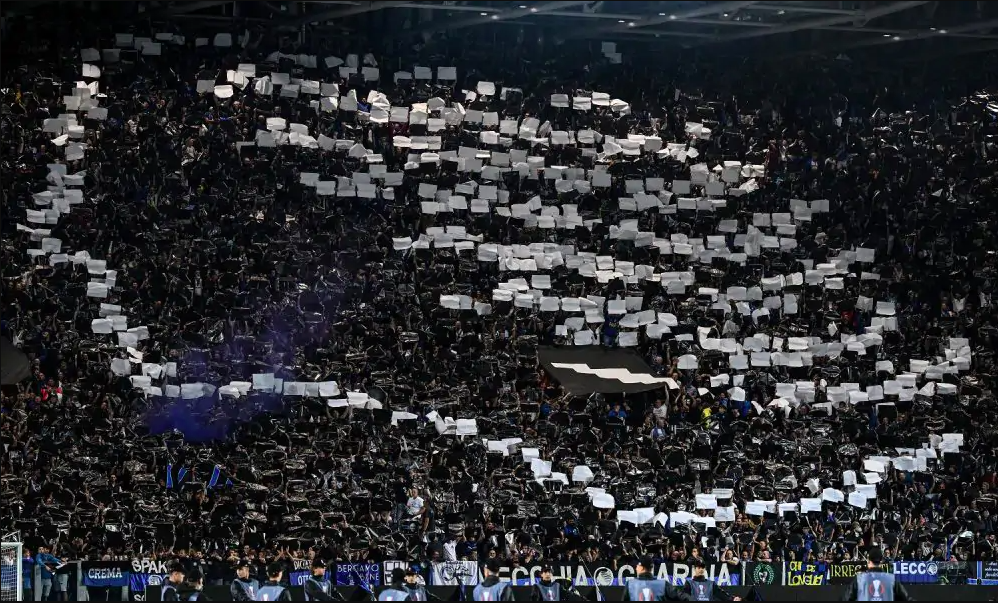
Federico Farcomeni considers the recent “gentrification” of Bergamo and what it means for fans of Atalanta. You can follow Federico’s weekly updates from the Curva on his Calcio Express substack.
Bergamo has always been one of the ultimate Italian away trips.
If you attended Atalanta away it meant you were one of the tough guys.
Before police escorts became the norm, the perilous walk from the Stazione di Bergamo to the Comunale (as it was then known) had acquired a legendary status. Now you even pass by an official club shop as you head towards La Città Alta (the high city – Bergamo’s historic old town).
Nowadays, as soon as you leave the motorway, you’re redirected to a car park where shuttle buses take you to the away end. The adrenalin is still rushing but not as high as it used to, even though you still approach the now renamed Gewiss Stadium under a heavy police presence and with the bus doors left open as a statement of intent.
Vast perspex barriers separate visitors from locals on either side of the away end. Any confrontation between opposing sets of fans is now limited to insulting chants or gestures, as Arsenal, Celtic and Real Madrid fans will know from recent experience.
And to think that Atalanta had to play their home games in Reggio Emilia, some 116 miles away, when they returned in Europe after a 26 year absence as they welcomed Everton, Lyon and Borussia Dortmund in the 2017-18 season because their stadium didn’t meet all UEFA criteria.
Atalanta’s Golden Age
If you are lucky enough to have lived through that golden age, or rather bump into one of the old pictures of yesteryear, to the modern eye, it’s startling to see the big gap between the metallic terrace of the away end and the metallic fences, Carabinieri storming the pitch to restore order, or rather Guardia di Finanza dressed up in antiriot gear forming a cordon to prevent clashes with the Atalanta ultras of the Curva Sud nearby.
Everything that has happened in Bergamo in the last seven years can be summed up in one word: gentrification. Both on and off the field. Gian Piero Gasperini, the longstanding Nerazzurri coach, performed miracles by consistently qualifying for Europe, reaching the last eight of the Champions League and finally lifting the Europa League trophy in the final against Bayer Leverkusen in Ireland in 2024
Previous generations of Atalanta fans, who had experienced no less than 12 promotions from Serie B (a record they share with Brescia), could only have dreamed of such heights.
That’s why Atalanta’s ultras of a certain vintage displayed a banner when La Dea hosted Olympique Marseille in the 2023/24 Europa League semifinal second leg which read: “The memory of Mechelen evoked in every child, winning today helps us tell the story of Dublin”.
European Glory
Those games against K.V. Mechelen (or Malines) are still the benchmark for all provincial sides fighting the status quo, as La Dea somehow reached the Cup Winners’ Cup semifinals in 1988 as a Serie B side.
“These are our European pirates” was the Gazzetta dello Sport’s headline previewing the game in Belgium on 6 April 1988. “To this day, my best memory in supporting Atalanta dates back to 20 April 1988 – recalls Giovanni Battista Perego, a season ticket holder for 20+ years. “That night, for the semifinal second leg, we were 37,000 pushing on La Dea in a 20,000 capacity stadium. I still don’t know whether that emotion really matches winning a European trophy for real some thirty years later.”
“The old Curva Nord – says Mr Perego – just thinking about it makes me emotional. It was a stand with a soul. Those who stood there had the Goddess in their DNA. You always went with enthusiasm, regardless of sun, rain, or snow, as long as you were on the concrete steps cheering on the Magica with friends and true fans. Serie A, Serie B, Serie C, it didn’t matter. So many great memories. It was a different kind of support, more natural because everyone was pulling in the same direction. Going to the stand was a way of coming together, you felt part of a community, a family, even though we didn’t all clearly know each other”.
“A sense of gentrification”
“The new Curva Nord, like the entire stadium, is beautiful. You can see the game better, it’s a little gem, but it lacks the spirit it once had. There’s a sense of gentrification among people, the warmth of true fans is missing. Unfortunately, now there are too many people who don’t have the spirit of the stand. People fight over seats or keep them with their scarves for the late comers, but that wasn’t always the case. Before, no matter what time you arrived, the concrete steps were ready to welcome you, the crowd was ready to find a seat for you, because everyone was driven by the same intention. The game was the secondary reason for being at the stadium – cheering and supporting the team was the priority”.
Ultimately, success has come at a cost and, as painful as it sounds, Atalanta – the huntress of Greek mythology – had to sell part of its soul in order to finally earn silverware. Although you could argue that much of the original DNA has been transferred to the new stadium, it seems increasingly difficult in modern football to remain true to your roots off the pitch while hunting for glory on it.
Words Federico Farcomeni
You can follow Federico’s weekly updates from the Curva on his Calcio Express substack.