
Hellas Verona’s Bentegodi Stadium is one of the last surviving relics of a bygone age. Substantially renovated to host the 1990 World Cup, its glory days came in the mid-1980s when Osvaldo Bagnoli’s team of rejects and journeymen clinched a historic Serie A title. From the disused running track to the bleak concrete stairwells, little has changed since those halcyon days of yore. But this Sunday will see a dramatic first for the tired old stadium, as Richard Hough, author of Verona Campione, the Miracle of 85, reports.
Today, devoted football fans from across Europe, many inspired by the seminal Tim Parks book, A Season with Verona, make regular pilgrimages to the Verona’s Bentegodi Stadium where they can still drink, smoke and yell abuse at opposing sets of fans like it’s the 1980s. And all at a fraction of the cost of any other top-flight football stadium in Europe (tickets for Sunday’s double header are on sale for between €2 and €25 with pints inside the stadium being served at the discounted price of €2.50).
With new American investors (Texas-based Presidio Investors took over the club in January), there are signs that things may be changing. With the Bentegodi amongst the candidates to be a host stadium for Euro 2032, proposals have recently been submitted for an ambitious public-private redevelopment of the stadium with the objective of transforming the current site into a modern multi-purpose venue. But, with a potential price tag of €300 million, there are substantial bureaucratic and financial hurdles to overcome before any of those plans becomes a concrete reality.
Hellas Verona fans have a hard-earned reputation as some of the most extreme in Italy. But, although the atmosphere inside the Bentegodi remains lively, and fans were recently involved in violent street skirmishes with rivals in Pisa resulting in a three-month travel ban, the reality is that there is rarely trouble in and around the stadium itself and that the overtly racist incidents of the past now seem to belong to another era.
While it would be overstating it to say that the club has gone woke, the invitation extended to the women’s team to play their next league game at the stadium in a back-to-back fixture with the men is perhaps a sign that attitudes are softening.
It would be an exaggeration to say that women’s football in the city is thriving, but there are clear signs that it is now being taken more seriously than ever. From grassroots to the professional game, in Verona, women are participating like never before, as coaches, referees and players. With Nielsen Sports, a global leader in fan intelligence and sponsorship analytics, predicting that the women’s game is on course to reach 800 million fans by 2030, becoming the fifth largest sport in the world, it is no surprise that Verona’s new investors want to grab a slice of the action.
In fact, the women’s game has a proud if little known history in Verona. Olimpia Verona, the first women’s football club in the city was founded in 1969. In 1976, it became ACF Verona and competed in Serie A until the 1985-1986 season. The club’s name changed frequently during that period, reflecting the various endorsements and sponsorship deals that sought to keep the fledgling women’s game alive.
The golden age for the women’s football in the city came with the foundation of A.C. Foroni in 1989. After officially joining the Italian football federation in 1994, Foroni were promoted to Serie A in 1999 and quickly became one of the leading women’s football teams in the country, winning the championship in 2003 and 2004, preceded by the Coppa Italia in 2002. The club then ran into serious financial difficulties and was dissolved at its peak in 2004. The lineage of Foroni Verona continued with Bardolino Verona, a team based around the popular lakeside town. In 2011, the club moved to Verona and was renamed AGSM Verona, a local electricity supplier this time providing the naming rights. Throughout this period, the club won five Italian championship titles, three Coppa Italias and two Supercoppe.
The city’s predominant women’s team is now known as Hellas Verona Women and competed in Serie A before being relegated to Serie B in 2022.
Throughout much of this period, the women have played at Stadio Aldo Olivieri, a smart 3,000 seat capacity stadium located in the playing fields behind the Bentegodi.
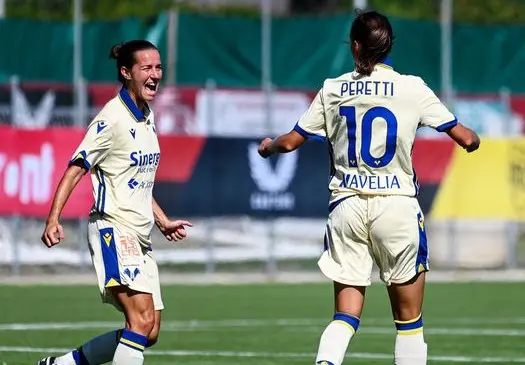
That was until club president Italo Danzi’s recent announcement that the women would be playing at the Bentegodi for the first time alongside the men in a historic double-header. You only have to see the reaction of the players to the announcement to understand what it means to them.

Matteo Fontana, a long-standing documentarian of the local football scene and local correspondent for the Gazzetta dello Sport, notes that the initiative reflects the intention of the club’s new American owners to give greater prominence to the women’s game. “Naturally”, he says, “the centrepiece will be the men’s game against Parma, but the women’s match provides an intriguing side dish, giving greater impetus the women’s game in this country.”
At Birreria Iter, the expansive beer hall just round the corner from the stadium, they are not planning anything special to mark the occasion. Enrico Martelletto, the bar’s welcoming co-owner and manager, is frank: “women’s football doesn’t bring any revenue to the pub yet, so there’s nothing special planned because it’s still not very well known.” While acknowledging that won’t change overnight, Enrico recognises the significance of Sunday’s initiative as an important step in the right direction and guarantees that fans of the women’s game will always receive a warm welcome.
On the pitch, local sports journalist Andrea Molinari identifies club captain Rachele Peretti and top goalscorer Valentina Colombo as key players to keep an eye on. Peretti is a local girl, reflecting the overwhelming number of Italians in the women’s team (in stark contrast to the men’s squad which has just two Italians), and she’s one of the most experienced players in the team. Colombo arrived in Verona during the summer transfer market and has already made an impact, with six goals including two against Como last week.
In terms of what to expect from Verona’s notorious Curva Sud, little is known. In the absence of any official declaration, I spoke to a few sources from inside the Curva but they remained tight lipped, insisting however that the women would receive a warm welcome from the club’s notoriously loyal fanbase.
Much, it seems, will depend on the outcome of the men’s game against Parma. But, it would be nice for one of the last great bastions of Italian masculinity to give its women the welcome they deserve on Sunday afternoon when they finally make their debut at the spiritual home of football in the city.
Richard Hough is author of Verona Campione, the Miracle of 85.
This is amazing! ⚽💖 Women’s football is finally getting the recognition it deserves, and seeing Hellas Verona Women play at the Bentegodi alongside the men is a huge step forward. 🙌✨ At http://www.westdelhiescorts.com, we always celebrate strong, inspiring women breaking barriers and making history! 💃🔥